INTRODUCTION
The seats are of vital importance in terms of comfort and safety: they are, in effect, the element that has to absorb the kinetic energy acquired by the body through the effect of stresses when cornering and during acceleration/deceleration.
The front seats, in the front part of the seating area, have an excellent structure for anti-submarining, to prevent the body sliding forward under the seat belt in the case of severe frontal impacts. This also contributes in great measure to limiting injury to the abdomen and femur by reducing the body's forward acceleration.
Comfort
For ensuring comfort and damping vibrations induced by the road, the seats are provided with effective spring system in the ischiococcygeal (sitting) area.
Cushion upholstery
With a high degree of containing curves, optimal lift of 35 ±3 kg
Cushion springs
Harmonic wire grid anchored to the structure with a co-moulded plastic cover
Backrest upholstery
Designed for good side containment, with a lift of 23 ±2kg
Seat back springs
To support the back, the seat is provided with a spring system specifically designed and dimensioned to perfectly adapt to the occupant's back.
The driver's seat is provided with lumbar adjustment; this feature is optional for the passenger's seat.
Seat structure
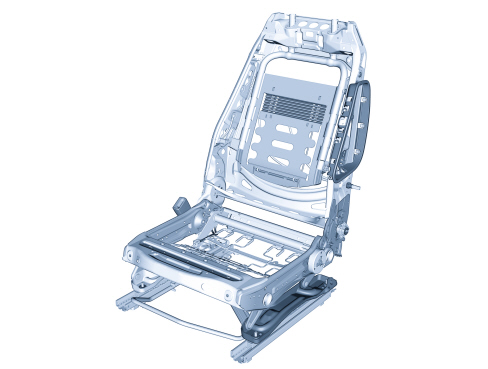
Functions
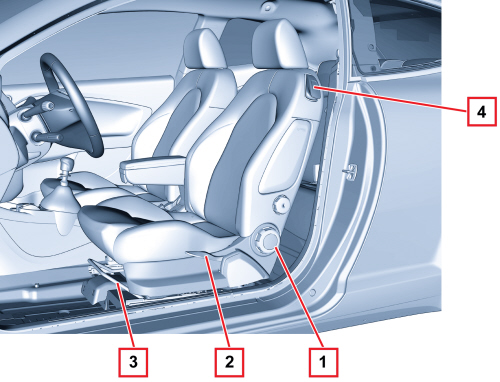
1 - Backrest adjustment knob
2 - Height adjustment lever
3 - Lengthwise adjustment release lever
4 - Easy Entry lever
1 - Backrest adjustment
The backrest reclination is continuous and adjusted by a knob in the backrest joint on the outside of the seat (max. control torque Max 2.5Nm).
2 - Height adjustment
Present on driver's side and operated by a ratchet lever with low operating loads (55Nm – 60 mm stroke): use is favoured by its particular shape and arrangement.
3 - Lengthwise adjustment
Adjusted by means of an arch-shaped lever is located in the lower part of the cushion which frees the sliding guides. The longitudinal sliding guides have a slight, 3° inclination (interface on floor) to make the seat rise as it advances (guide stroke 240mm, selectivity 10 mm, forward sliding load 120Nm).
4- Easy entry function
Seats are equipped with a memory guide system for arranging the seat in the initial position after folding and sliding it forward to access the rear seats). The mechanism is actuated by a control lever on the end of the backrest on door side (a spring assists folding).
Heated seats
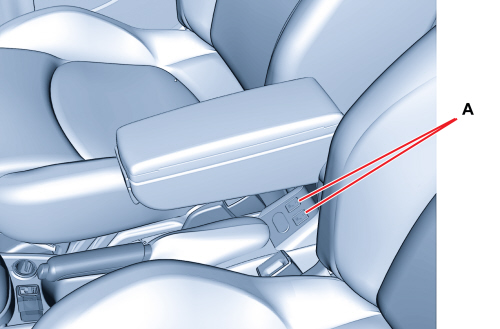
This is an optional feature (passenger and driver's seats). The heater is glued to the backrest/cushion padding. The control button is on the vehicle system (not on the seat): On – Off button (no adjustment).
The heater starts at 20°C and goes off at 40°C
The buttons (A) locate on the centre console, in the area of the gear lever, control the operation of the heater pads inserted in the seat cushions and backrests.
Lumbar adjustment
This feature is standard for the driver and optional for the passenger; the control knob is on the backrest (door side).
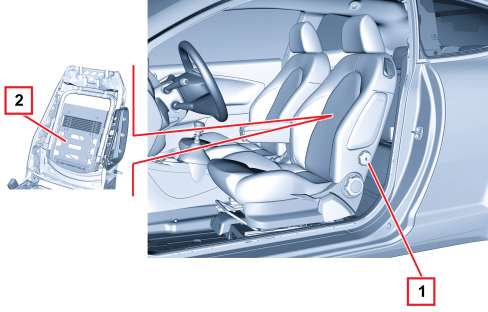
1. Lumbar adjustment knob
2. Lumbar stiffening structure
Head restraints
In rear impacts at low speed the most common injury is whiplash.
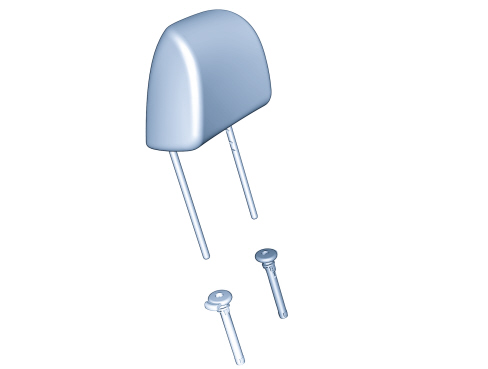
To reduce the risk of this injury to a minimum, the vehicle is fitted with head restraints capable of retaining the head in the case of rear impacts preventing irregular or excessive stresses to the cervical group of the vertebral column. The size of the head restraint in relation to the position of the neck and the stiffness of the head restraint are therefore important with regard to the performance of this function.
Sliding head restraints are provided with a steel structure (full rod, diameter 2 mm) with traditional upholstery, polyurethane foam and PPE insert. They are adjusted in height by means of a button with a total stroke of 45 mm.
The padding of all head restraints is optimised for comfortable support. The shape and position is designed according to the most recent ergonomic studies reducing the distance between neck and head restraint so as to prevent whiplash.