SPECIFICATIONS
The front doors have been designed with a structure and panels that feature no sharp corners thereby keeping the risk of possible injury to the occupants to a minimum.
The locks and control linkage are protected against a break in from outside the vehicle.
The safety lock, from inside the vehicle, is activated by a dedicated button in the dashboard.
The door panel features an armrest, directly in the panel and an oddments pocket in the lower part. The arrangement of the panel functional elements has been designed for correct interaction with the occupant's body in the case of a side impact.
The door also contains:
- exterior opening/closing handle;
- outside side mirror.
- two speakers, one housed in the door mirror trim;
- an oddments pocket;
- door interior opening lever;
- window winder controls;
- controls for adjusting door mirrors (driver's side only);
The sliding window is made from heat-proof, tempered glass and is moved by a guided cable type window opening device.
The seals ensure perfect protection from wind noise.
COMPOSITION
Exploded view of the front door
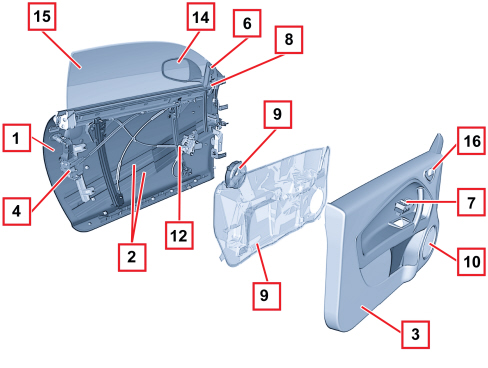
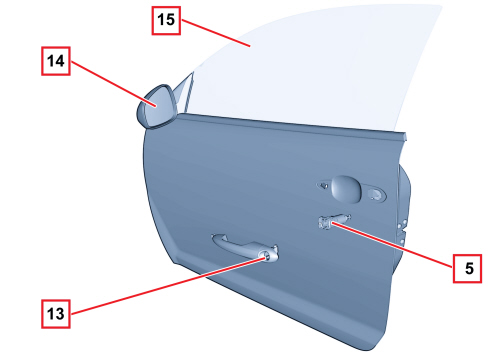
1 - Door frame
2 - Anti-intrusion bars
3 - Door inner panel
4 - Lock
5 - Key barrel
6 - Corner cover
7 - Driver's door control panel
8 - Tweeter
9 - Speaker
10 - Speaker grille
11 - Water guard protection
12 - Window opening device
13 - Exterior handle
14 - Rear view mirror
15 - Window
16 - Exterior handle
PASSENGER COMPARTMENT ACCESS
The Vehicle Protection System with central locking for the doors and the boot using a remote control has been designed with a high level of protection against a break in.
The Body Computer manages the electric locks and controls as listed below:
- Locking/unlocking motor
- Motor with dead-lock anti-break in device on the doors
- Boot release actuator
- Switch in key pawl on the only driver-side door for central locking using mechanical key
- Passenger compartment interior button for locking/unlocking doors
- Button (“logo”) on tailgate
Remote control
The radiofrequency remote control is fitted with a retractable mechanical insert. It has an operating radius of about twenty metres.
It works in conjunction with the central locking system and has three buttons which perform the following functions:
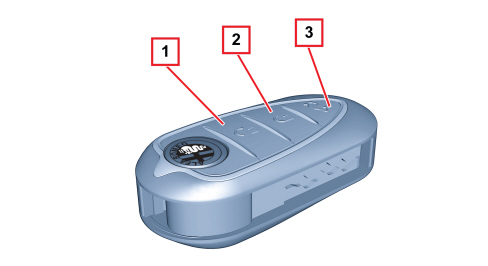
1 - Opening button
2 - Closing button
3 - Boot button
Opening button
The following takes place when it is pressed briefly: remote unlocking of the doors and the tailgate with the alarm (where fitted) being switched off at the same time, timed switching on of the interior courtesy lights and two flashes of the direction indicators.
The following takes place when it is pressed for a while (more than 2 seconds): opening of windows and courtesy lights on; when the button is released the windows stop in their current position.
Closing button
The following takes place when it is pressed briefly: remote locking of the doors and the tailgate with the alarm (where fitted) being switched on at the same time, timed switching off of the interior courtesy lights and one flash of the direction indicators
When the button is pressed twice quickly, the Dead Lock is activated.
If one or more of the doors is open, the locking is not carried out. This is signalled by the LED in the dashboard flashing rapidly and the direction indicators.
The following takes place when it is pressed for a while (more than 2 seconds): closing of windows and courtesy lights off; when the button is released the windows stop in their current position.

|
If the battery is run down, 100 activations are still guaranteed with the correct transmission of the data. |
Luggage compartment opening
Pressing the button produces the remote release (opening) of the tailgate with the alarm (where fitted) switched on.
The opening of the tailgate is signalled by the direction indicators flashing twice; when it is closed there is one flash (only with the alarm on).
If an alarm is fitted, when the tailgate is opened, the alarm system switches off the volumetric protection and the perimeter sensor for the tailgate.
When the tailgate is closed again, the volumetric protection and perimeter sensor are restored.

|
FUEL FLAP: the fuel flap is opened manually, whilst the cap on the tank is opened using a mechanical key. |
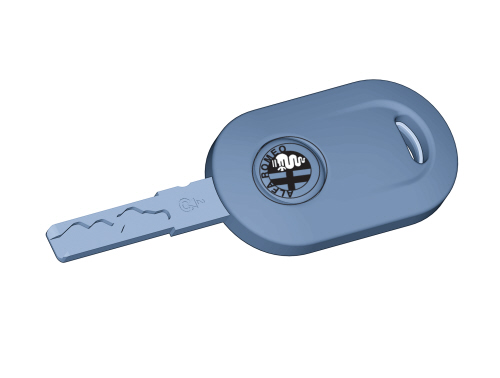
Mechanical key
There are two types of mechanical key: extractable or with a fixed insert.
Extractable key
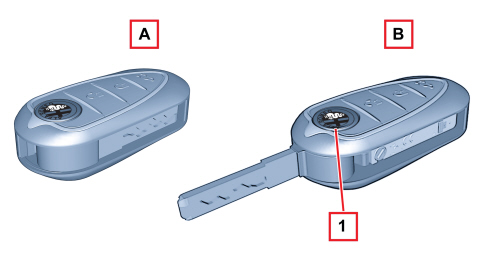
A - Key closed
B - Key extracted
1 - Key extraction button
Mechanical key
Signalling led
A RED signalling LED is located in the controls in the centre of the dashboard next to the locking/unlocking button.
When the doors are locked the LED comes on for a few seconds after which it starts to flash (deterrent function).
If one of the doors or the tailgate are not properly shut when the doors are being locked, the LED flashes quickly together with the direction indicators.
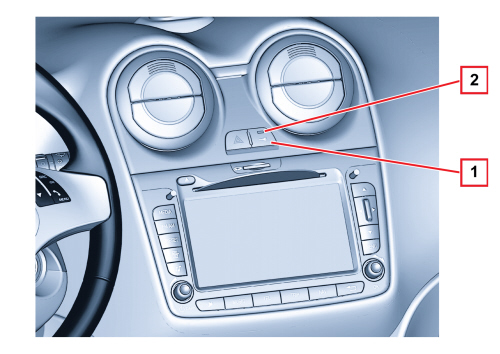
1 - Door locking / unlocking button
2 - Signal LED
Operation
Locking of locks from the outside
With the doors closed, press the button on the remote control to lock the doors or insert and turn the metal key insert in the door lock on driver's side.
A LED will light up in the middle of the dashboard to indicate that the doors have been locked.
The door lock is activated:
- with all the doors closed;
- with all the doors closed and the tailgate open.
Unlocking of locks from the outside
Press the corresponding button on the remote control or insert the metallic insert of the key in the lock in the driver's door.
Locking/unlocking of the locks from the inside
Press the button in the middle of the dashboard.
The button has an LED that indicates the status (doors locked or unlocked): LED on: doors locked
Press the button again to unlock all doors and switch the LED off: LED off: unlocked door.
Press the button again to lock all doors.
The locking of the doors is only activated if all the doors are properly shut.
The doors cannot be unlocked using the button in the middle of the dashboard if the doors where locked using the remote control or door lock.
|
|
With the central locking system on, pull the door lever of one of the doors to open that door only (the LED on the button will stay on if it is the passenger's door). |
|
|
If there is no power supply (battery disconnected, etc.) the doors can be locked manually. |
Luggage compartment
The tailgate lock is electric and deactivated when the vehicle is moving.
When unlocked, press the button (Alfa Romeo Logo) until the click or press the corresponding button on the remote control to open the tailgate from the outside of the car.
The direction indicators and internal light will blink twice when the boot is opened: the light will go out automatically when the boot is closed. The light will go out automatically after a few minutes if the tailgate is forgotten open.
Dead lock mode
This is a safety device that inhibits the operation of:
- interior handles;
- locking/unlocking button;
thereby preventing the opening of the doors from inside the passenger compartment if there has been a break in attempt (e.g. a window has been broken).
The dead lock device therefore offers the best possible protection against break in attempts.
The dead lock function is engaged by pressing the door locking button on the remote control twice (within a second).
If one or more of the doors are not properly shut, the dead lock is not switched on: this prevents someone from entering the vehicle through an open door and then getting locked inside when they close the door.
The switching on/off of the dead lock function is confirmed by the direction indicators flashing 3 times and the signal LED flashing.
The function is switched off automatically for all the doors in the following cases:
- if the key is turned twice in the driver's door;
- carrying out the operation of unlocking the doors using the remote control;
- if the ignition key is turned to the ON position.
The dead lock function also inhibits the door locking/unlocking button in the passenger compartment.

|
It is impossible to get out of the passenger compartment with the dead lock switched on. |
|
|
If the battery is run down/not working properly or disconnected, the dead-lock function can only be switched off in a door that has a catch using the mechanical key from the outside; the dead-lock function remains operational for the other doors ! |
Automatic central locking
The automatic locking function for the doors can be enabled or disabled when the speed of the vehicle exceeds 20 km/h using the set up menu in the instrument panel.
Opening/closing windows
All the door windows can be closed when the doors are being closed by keeping the key turned or pressing the remote control button for a while.
The windows continue to move as long as the key is turned.
In the same way the windows can be opened when the locks in the doors are unlocked.
ELECTRIC WINDOWS
The electric window controls are arranged on the driver's door.
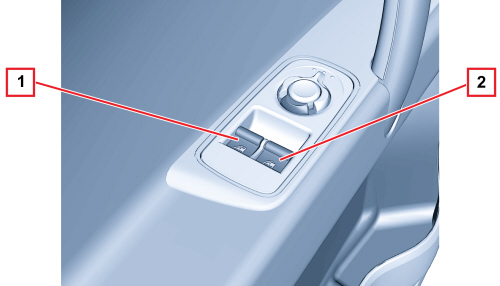
1 - Driver-side door control
2 - Passenger side door control
Electric window operation
The electric windows can be operated both manually and automatically, following the logic described below:
- if the button is pressed for between 60 and 300 milliseconds, operation is manual: the glass only goes up/down when the button is pressed;
- if the button is pressed for longer than 300 milliseconds, operation is automatic: even if the button is released, the glass continues to go up/down until the end of travel or the implementation of the anti-crush safety system if fitted.
- pressing the button again whilst the window is moving stops it in the position it is in;
- if the button is pressed for less than 60 milliseconds, this is ignored (it is treated as an accidental knock).
For all the windows the window opening function is only active with the ignition on, with the following exception: after a key off, the front windows can be operated manually or automatically for a period of 3 minutes. When this timed period elapses the system no longer acquires new commands.
If one of the doors is opened during the timed period, new commands are longer acquired, but any commands received before the opening of the door are brought to a conclusion.
If one of the doors is already open at the key off, any commands received before the opening of the door are brought to a conclusion.
Centralized activation of windows
This is a function that allows the side windows to be completely closed in a single operation.
All the door windows can be closed when the doors are being closed by keeping the key turned or pressing the remote control button for a while.
In the same way the windows can be opened when the locks in the doors are unlocked.
Anti-crush safety function
The anti-crush safety function guarantees the reversal of the direction of the electric window any time the presence of an obstacle is detected (e.g. a finger, hand, etc.) whilst the glass is moving, thereby preventing accidental crushing.
This feature provides a high degree of safety especially for any children on board.
The super-opening and super-closing of the windows can be activated on leaving the vehicle.
The anti-crush safety function is activated both during the manual and the automatic operation of the window.
There are two inversion and non inversion zones for the anti-crush safety system:
- the "inversion zone" corresponds to the space between 200 mm from the upper edge and the upper edge itself;
- the "non inversion zone" corresponds to the remaining space.
If, whilst the window is closing, the presence of an obstacle is detected in the "inversion zone", the system interrupts the upwards movement and reverses the direction immediately.
If, on the other hand, the presence of an obstacle is detected in the "non inversion zone", the system interrupts the upwards movement of the window.
No type of command is accepted during this period.
|
|
If the anti-crush protection intervenes five consecutive times within a minute or is faulty, the automatic closing operation of the window is inhibited, only allowing it in steps of half a second the button is released for the subsequent manoeuvre. |
In order to restore the correct operation of the system, one of the following conditions must be satisfied:
- a key off - key on operation
- a downwards movement of the window in question made by the user.
The anti-crush safety function is produced by means of a Hall effect sensor which detects overloading of the electric window motor: the intervention threshold is set when the force of the obstacle encountered along the window travel (e.g. a finger, a hand) exceeds 7-8 kg.
Short drop function
When the doors are opened (both at the key on or the key off), the door nodes activate the short drop function to prevent interference between the glass and the roof.
In detail, this means that if the glass is rising when the door is opened, the window opens to the short drop position and not to the full closure position.
The Short Drop position is fixed at 8 mm (from the windows completely closed position).
If the position of one or both of the window glasses is already at the level of the short drop position, no automatic movement takes place.
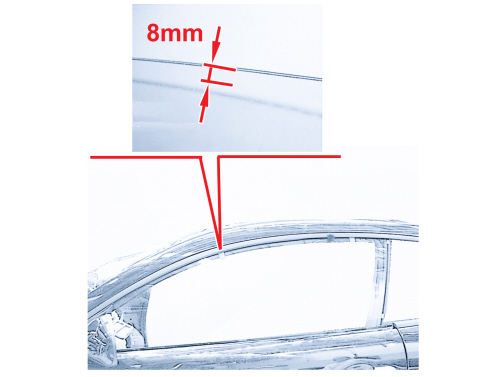
If the position of one or both of the window glasses is already at the level of the short drop position, no automatic movement takes place.
Electric windows initialization
|
|
the restore operation must be performed as follows with the doors closed. |
1. completely open the driver's door window keeping the operating button pressed for at least 3 seconds after the (lower) end of travel position;
2. completely close the driver's door window keeping the operating button pressed for at least 3 seconds after the (upper) end of travel position;
3. proceed in the same way also on the passenger's side door;
4. Make sure that the initialization is correct by checking that the windows work automatically.
When this procedure has been carried out, the anti-crush system and the automatic operation of the electric window are working.
|
|
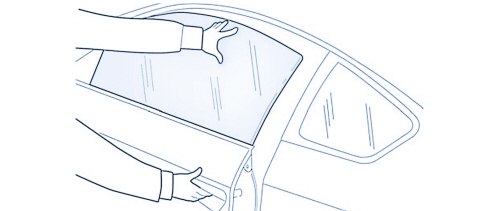
Lacking power (blown fuse, battery disconnected, etc.) it is however possible to lock the doors manually. In this case, the automatic opening function of the windows is not available. Press the window towards the inside of the car as shown in the figure to open or close the door with the window raised to ease the passage of the window into the moulding. |