AUDIO SYSTEM
The acoustic system for the vehicle comes in three distinct levels:
- standard radio (with CD / MP3 player), completes the audio system with 6 speakers;
- BOSE Hi-Fi sound system (with 8 speakers, subwoofer and multi-channel amplifier);
There is also the possibility of a Blue&Me infotainment system with Bluetooth radio telephone function and media player,
See descriptions 5570 ACCESSORIES
or Radio Nav navigation system
A PND (Portable Navigation Device) setup is offered as an alternative.The device can be installed in the middle of the dashboard.
See descriptions 5580M ON-BOARD NAVIGATOR

|
The car is equipped with a "RADIO SETUP" as described below, even if the radio is not requested. |
General specifications of the standard system
The system comprises 6 speakers as illustrated in the diagram:
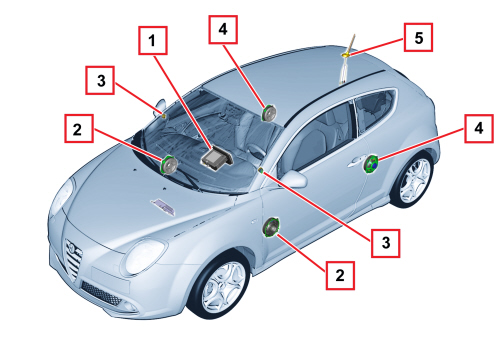
1 - Radio
2 - Front door midwoofer speakers
3 - Tweeter front speakers
4 - Midwoofer rear speakers
5 - Aerial
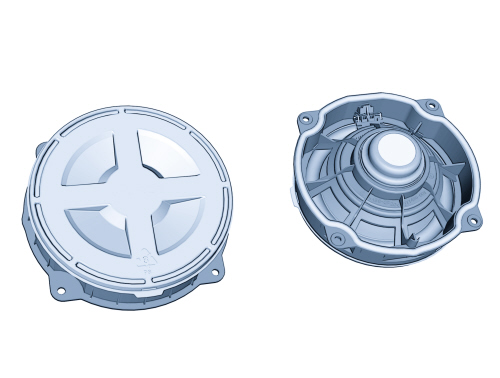
Front speakers
They are 165 mm diameter 40W mid-woofer speakers located in the front doors.
They are designed to reproduce medium-low frequencies.
The technology used for these components (water resistant) means that they can withstand jets of water inside the door without suffering damage.
It is a speaker with a paper cone, plastic support (ABS), ferrite magnet and aluminium coil support.
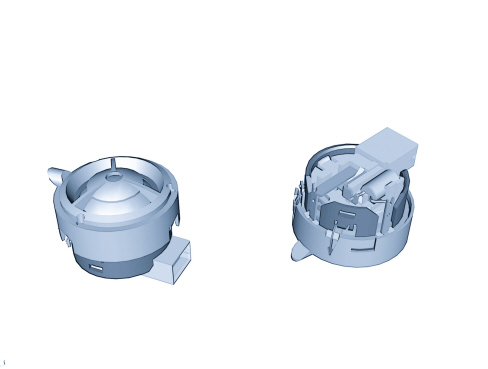
Front tweeters
These are 30W tweeter speakers located in the door panel triangular upper trim, designed to reproduce higher frequencies.
There is a dome tweeter with a polycarbonate cone, plastic support, ferrite magnet and copper coil support.
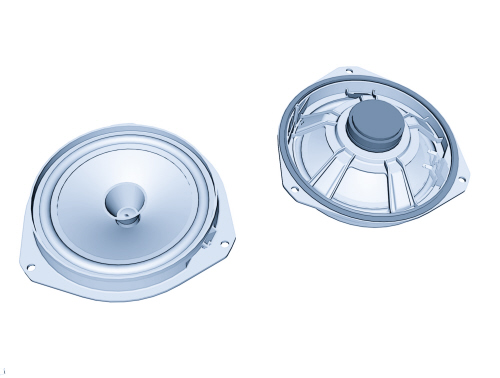
Rear speakers
These are 165 mm diameter, 40W full-range speakers located in the rear doors capable of reproducing the entire audio frequency range.
These components are also produced using water resistant technology.
There is a dual cone speaker with a paper cone, plastic (ABS) support, ferrite magnet and aluminium coil support.
Aerials
The structure of the aerials consists of:
- FM1 stylus aerial mounted at the back in the centre of the roof;
- FM2 aerial which uses the heated rear windscreen heating elements;
- telephone (GSM) and navigation (GPS) aerial mounted on the roof (used with Blue&Me Nav);
See descriptions 5580M ON-BOARD NAVIGATOR
- navigation only aerial (GPS) mounted on the roof (used with the Radio Nav);
See descriptions 5580M ON-BOARD NAVIGATOR
The FM2 aerial on the rear window is used in addition to the stylus aerial when the radio or the radio navigator are provided with the PHASE DIVERSITY function. This function is based on a signal processor inside the radio which exploits the double antenna for tuning to the station with the best available signal instant by instant.
This considerably improves the quality of the FM signal received in all limit conditions, such as for example multipath distortions or co-channel interference.
The FM2 signal arrives from the heated rear windscreen filaments reaching a dedicated amplifier and goes to the radio module via a coaxial cable.
The FM1signal arrives from the stylus aerial which, on the most extensive version, includes the GSM aerial and the GPS aerial and a dedicated amplifier incorporated in the base of the actual aerial; it is then sent, via a coaxial cable, to the radio module.
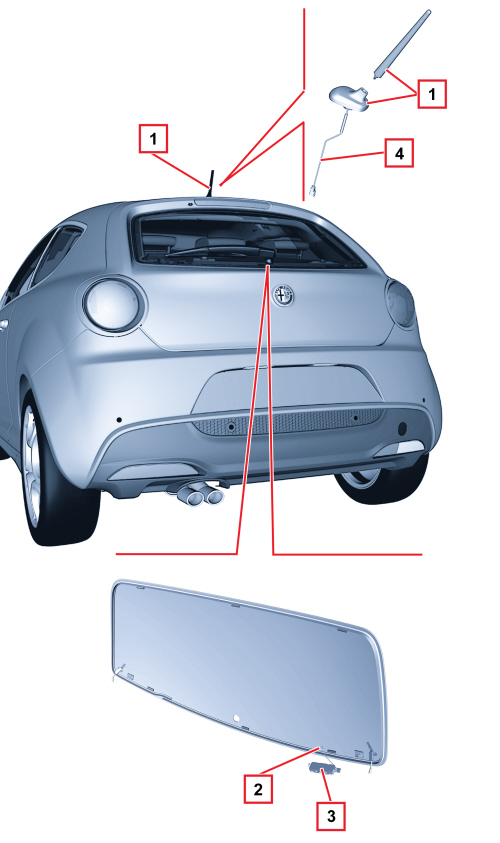
1 - FM1, GSM, GPS stylus aerial
2 - FM2 aerial connection incorporated in the heated rear windscreen
3 - FM2 amplifier
4 - aerial leads to radio module
Bose hi-fi sound system
A BOSE Hi-Fi Sound System is available on request.
The BOSE audio system features aggressive sound particularly suited to young people.
The system is composed of 8 speakers, a power amplifier and a subwoofer box for deep bass.
The system has been developed ad hoc for the vehicle: the acoustic properties of the passenger compartment have been carefully studied so that the amplifier and the speakers are ideally suited to the vehicle: optimum listening is available in any part of the passenger compartment.
Bose system
The BOSE hi-fi system for the model is controlled by a 8800 model amplifier with 4 analogue input channels and 7 stereo output channels.
The amplifier controls 9 speakers with different equalizers, delays and limiters.
A sub woofer with specific power amplifier is arranged in the spare wheel compartment. Four mid-woofers (diameter 6.5”) are arranged in the front doors and in the side panels.
Four tweeter are installed in the front doors in the rear view mirror and rear side panels.
Two front tweeters are controlled in independent manner by two specific channels optimised for crossover and balance.
Front and rear speakers
Mid-woofer speakers, diameter 165 mm, with paper cone, neodymium magnet and aluminium membrane.
They are positioned in the front doors and rear side panels.
Front and rear tweeters
These are Dome Tweeter with neodymium magnet, plastic cone and aluminium membrane.
The front speakers are located in the door panel upper triangular trim.
The rear speakers are located in the side panels above the mid-woofer speaker.
Subwoofer
The bass-reflex subwoofer box contains a 165 mm diameter speaker with its own amplifier, mod. 1000, for playing the deepest frequencies and is positioned in the boot in the spare wheel compartment.
Amplifier
The 8 channel amplifier (4 x 37 W rms and 4x18 W rms) controls all speakers.
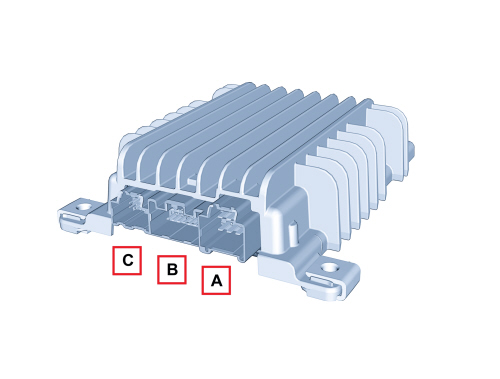
AMPLIFIER CONNECTION PIN OUT
Connector A
|
PIN |
SIGNAL |
|
A1 |
Left rear speaker output (-) |
|
A2 |
Right front speaker output (-) |
|
A3 |
Left front speaker output (-) |
|
A4 |
Battery power supply (+) |
|
A5 |
Left rear speaker output (+) |
|
A6 |
Right front speaker output (+) |
|
A7 |
Left front speaker output (+) |
|
A8 |
Chassis earth |
Connector B
|
PIN |
SIGNAL |
|
B1 |
Not connected |
|
B2 |
Not connected |
|
B3 |
Left front tweeter output (-) |
|
B4 |
Left front tweeter output (+) |
|
B5 |
Right front tweeter output (-) |
|
B6 |
Right front tweeter output (+) |
|
B7 |
Right rear speaker output (-) |
|
B8 |
Right rear speaker output (+) |
|
B9 |
Not connected |
|
B10 |
Not connected |
|
B11 |
Not connected |
|
B12 |
Mute signal |
|
B13 |
Not connected |
|
B14 |
Not connected |
|
B15 |
Subwoofer bassbox speaker output (+) |
|
B16 |
Subwoofer bassbox speaker output (-) |
Connector C
|
PIN |
SIGNAL |
|
C1 |
Microphone positive signal (NC) |
|
C2 |
Not connected |
|
C3 |
Not connected |
|
C4 |
Right rear speaker input (-) |
|
C5 |
Left rear speaker input (-) |
|
C6 |
Right front speaker input (-) |
|
C7 |
Left front speaker input (-) |
|
C8 |
Hi-fi amplifier enablement (input) |
|
C9 |
Microphone negative signal (NC) |
|
C10 |
Subwoofer bassbox speaker enablement (output) |
|
C11 |
Not connected |
|
C12 |
Right rear speaker input (+) |
|
C13 |
Left rear speaker input (+) |
|
C14 |
Right front speaker input (+) |
|
C15 |
Left front speaker input (+) |
|
C16 |
Car speed signal |
The amplifier is located under the dashboard, passenger side.
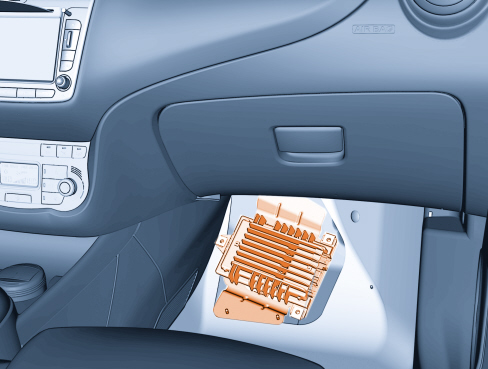
RADIO
The Radio Receiver Node (RRN) is in a DIN housing, usually located in the middle of the dashboard.
All versions are prepared for connection with the low speed CAN interface at the B-CAN to allow dialogue with the other system nodes. The following are transferred via this interface:
- Anti-theft code;
- On control (for switching-off logic);
- Speed dependent volume control;
- Lighting control;
- Remote controls from the steering wheel, where fitted;
- Repetition of radio information at control panel.
- Interface with Blue&Me, where fitted.
- Interface with AUX port, if present.
Specifications
Main features
- Music audio power: 4x30W
- 7 band graphic equalizer
- Digital tuner with variable selectivity.
- Built-in, large, alphanumerical display (2 lines with 12 characters for RDS functions + control symbol)
- Easily operated menu for adjusting radio settings or any outside interfaces
- Mute function produced by pressing the MUTE button briefly
- Soft mute, during radio source/station changing operations
- Volume adjustment depending on the vehicle speed (selected using the menu)
- Radio switching off timer adjustment (immediately or 20 minutes after the key off)
- Phantom-Power aerial power supply.
- Remote control from the steering wheel (opt.)
- Possibility of interface with the CD-Changer
- BOSE Hi-fi system active control, where fitted
- Connection to Blue&Me hands-free system
- Anti-theft function.
Radio specifications (radio cd and radio cd/mp3)
- Digital tuner with variable selectivity
- FM multipath detector
- Possibility of selecting HICUT function (High-Cut:= dynamic reduction of treble if RF signal is poor)
- AM noise cancellation
- Autostore (automatic memorizing of radio stations with best signal)
- RDS (Radio Data System) with EON, AF (alternative frequencies), PI, PS, TA, TP, PTY and REG function (that can be selected by the user)
- Automatic and manual search for stations
- Possibility of adjusting Local/Distance for automatic frequency search- Possibility of programming:
- Possibility of programming:
. 18 FM stations (6 of which can be memorized through autostore).
. 6 MW stations
. 6 LW stations
|
|
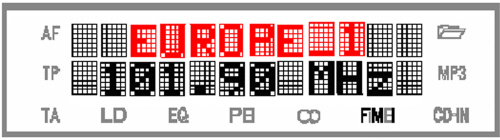
A radio turning frequency setting procedure is provided to switch between EUROPE (default) or SOUTH AMERICA or USA settings, if needed. To go from one configuration to the other hold buttons “FM” and “1” pressed for the long time within 5 SECONDS AFTER TURNING THE RADIO ON. The configuration will appear when the radio is switched on, as shown below. |
Mp3 cd specifications
- Motorized loading and ejection
- Select previous (next) track
- Up/down track selection
- Pause
- FF / F-REW
- MP3 Display (file, ID3-TAG information, track time elapsed, name of the file)
- Reading of printed audio or information CDs, CD-R and CD-RW.
Audio specifications
- Bass
- Treble
- Balance
- Fader
- Loudness
- Mute
- 7 band graphic equalizer: Preset (default), Rock, Jazz, Classic, User (can be personalized)
- Speed Volume Control
- Possibility of interface with outside amplifier.
Radio front section
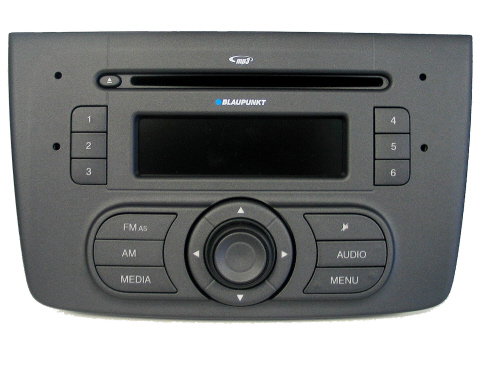
Display
The alphanumerical display is large with 20 characters for RDS functions and control symbols
The set configuration (e.g. EUROPE) will appear when the radio is switched on.
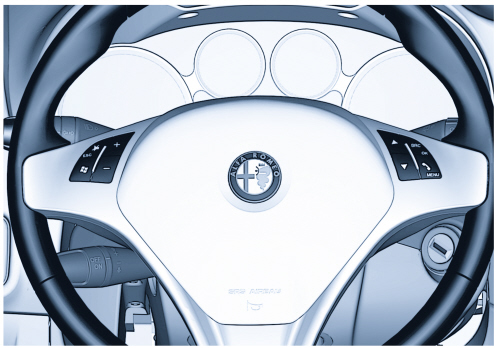
Remote controls on the steering wheel
There may be remote controls on the steering wheel for the radio:
Anti-theft code
The radio is installed in production and connected to the CAN to establish communication with the Body Computer, memorizing an anti-theft code known as an exchange code.
At each subsequent Key On (and even if the battery is disconnected), an automatic authentication procedure is repeated: the words "CAN CHECK" appear in the radio display: if the Exchange Code check is positive, the system begins to operate.If the codes compared are not the same, a message appears on the display asking the user to enter a manual code (Master Code - 4-figure code from 1111 to 6666) that is shown on the radio code card.
|
|
The Master Code is pre-programmed in production and different for each radio; it is also different from the Exchange Code. |
Entering the password
When the radio is switched on, if the password is requested, the display will show "CODE" for about 2 seconds followed by four dashes "- - - -".
The secret code is made up of four digits from 1 to 6, each corresponding to one of the dashes.
To enter the first digit of the code, press the button corresponding to the pre-selected stations (from 1 to 6). Enter the other code digits in the same way.
If the four figures are not entered within 20 seconds, the display again shows the message "CODE" for 2 seconds and then the four dashes "---". If this occurs, it is not considered an incorrect code entry.
After entering the fourth digit (within 20 seconds), the car radio will work.
If an incorrect code is entered, the radio will emit a sound and the display will show the word CODE for 2 seconds and then four dashes "----" to notify the user of the need to enter the correct code.
After three attempts the radio considers the last code as "incorrect"; each time the user enters an incorrect code, the waiting time increases gradually (1 min, 2 min, 4 min, 8 min, 16 min, 30 min, 1h, 2h, 4h, 8h, 16h, 24h) to a maximum of 24 hours. The waiting time is shown on the display with the words "RADIO BLOCKED, WAIT".
After the writing has disappeared it is possible to start the procedure of entering the code again.
Code card
This document certifies the ownership of the car radio. The Code Card contains the model of the radio, the serial number and the secret code.

|
The manual Master Code input procedure is necessary only if: the Body Computer is replaced or a radio already used on another vehicle with a CAN is installed. |
|
|
A "new" radio (which has never been fitted on other vehicles) can be fitted following an automatic authentication procedure without entering the master code manually. |
Operation at key off
The following function can be selected using the radio setup menu:
- if the radio is on at the time of the key off, it is automatically switched off after 20 minutes (or at another value selected using the menu); it can be kept on for a further 20 minutes by pressing the ON button.
The following can be selected in the setup menu under the item "- - - I G N I T I O N - T I M E R - - -".
"- - O F F - A F T E R - 0 0 - M I N - -"
"- - O F F - A F T E R - 20 - M I N - -"
Connectors
Rear view:
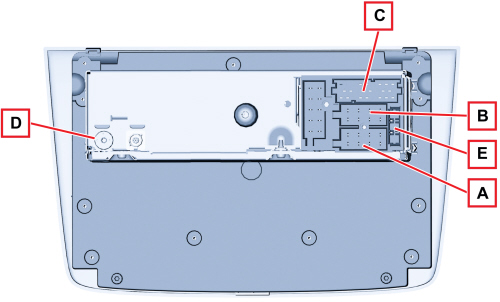
A - Power supply connector
B - Speaker output connector
C - Auxiliary functions connector
D - Aerial connection
E - Housing for 10 A fuse
Connector pin out
Connector A:
|
Pin |
Function |
|
A1 |
B Can B (high) |
|
A2 |
Positive amplifier recognition signal (only with Hi-Fi) |
|
A3 |
B Can A (low) |
|
A4 |
+30 power supply from F36 |
|
A5 |
Supply for subwoofer enablement (only with Hi-Fi) |
|
A6 |
Control lighting power supply (N.C.) |
|
A7 |
+15 supply (N.C.) |
|
A8 |
Earth |
Connector B:
|
Pin |
Function |
|
B1 |
Right rear speaker + |
|
B2 |
Right rear speaker - |
|
B3 |
Right front speaker + |
|
B4 |
Right front speaker - |
|
B5 |
Left front speaker + |
|
B6 |
Left front speaker - |
|
B7 |
Left rear speaker + |
|
B8 |
Left rear speaker - |
Connector C:
|
Pin |
Function |
|
C1 |
Left AUX signal |
|
C2 |
Right AUX signal |
|
C3 |
AUX signal |
Connector E connection with CDC (optional):
|
Pin |
Function |
|
E13 |
CDC data IN |
|
E14 |
CDC data OUT |
|
E15 |
Permanent power supply for CDC |
|
E16 |
Positive signal for CDC power supply enablement |
|
E17 |
CDC data GND |
|
E18 |
CDC audio GND (or AUX GND) |
|
E19 |
L input for CDC (or AUX socket) |
|
E20 |
R input for CDC (or AUX socket) |
AUX socket
In the versions with "Blue&Me", an external source can be connected to the AUX input, installed together with the "Media Player" USB port used by the "Blue&Me" system.
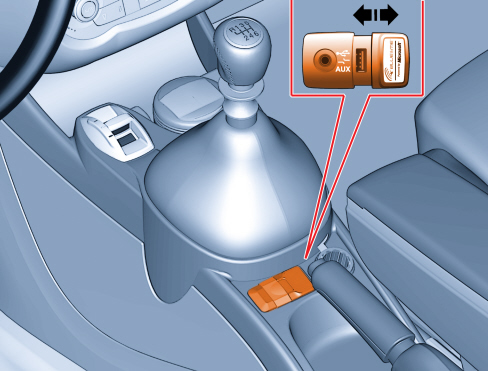
Aux mode
To activate the AUX source, press the MEDIA button or the SRC steering wheel control several times till the corresponding source is displayed.
|
|
The functions of the device connected with the AUX socket are directly managed by the device itself; it is not possible to change track/folder/playlist with radio or steering wheel controls. |
|
|
|
In AUX mode the "AUX Offset" function is available which allows the alignment of the portable device volume to the one of the other sources.
RADIO WIRING
If no car radio was requested at the time of purchase, the vehicle is provided with a double compartment on the dashboard (A).
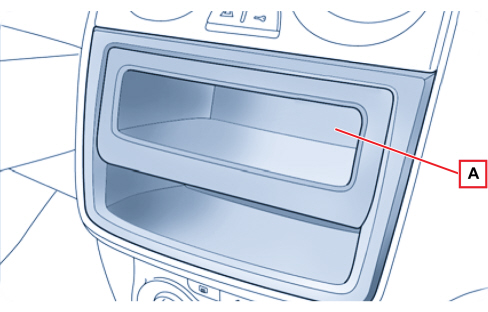
The radio setup system is composed of:
- car radio power supply cables, front and rear speakers and aerial;
- radio housing;
- aerial on car roof.
Connector pin out
Connector A:
|
Pin |
Function |
|
A1 |
NC |
|
A2 |
NC |
|
A3 |
NC |
|
A4 |
+30 power supply from F36 |
|
A5 |
NC |
|
A6 |
Controls lighting power supply |
|
A7 |
+15 power supply from F51 |
|
A8 |
Earth |
Connector B:
|
Pin |
Function |
|
B1 |
Right rear speaker + |
|
B2 |
Right rear speaker - |
|
B3 |
Right front speaker + |
|
B4 |
Right front speaker - |
|
B5 |
Left front speaker + |
|
B6 |
Left front speaker - |
|
B7 |
Left rear speaker + |
|
B8 |
Left rear speaker - |