Mc Pherson type independent wheel layout, with the shock absorber and the spring acting as both damping and flexible elements as well as structural and kinematic elements.
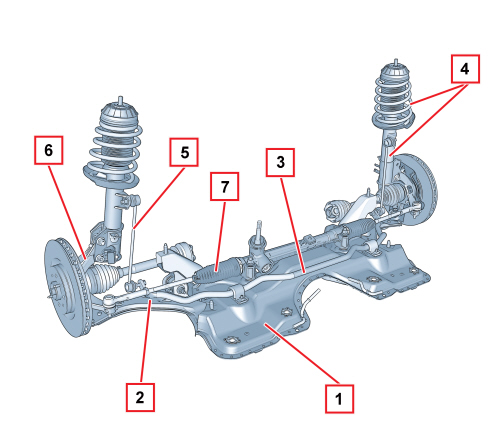
1. Crossmember
2. Track control arm
3. Anti-roll bar
4. Spring-shock absorber assembly
5. Anti-roll bar joint
6. Steering knuckle
7. Steering box
Crossmember
The suspension crossmember is made in galvanised steel with high structural rigidity with transverse connecting "band" near the front mountings for the track control arms.
The crossmember is attached to the bodyshell by four fastenings, two rigid ones at the front and two at the back with flexible bushes.
There are four anti-slip washers between the crossmember and the body.
Track control arms
The track control arms are in two parts and come in pressed steel (with patented "butterfly" structural layout) i.e. reduce number of welds to reduce the unsuspended masses.
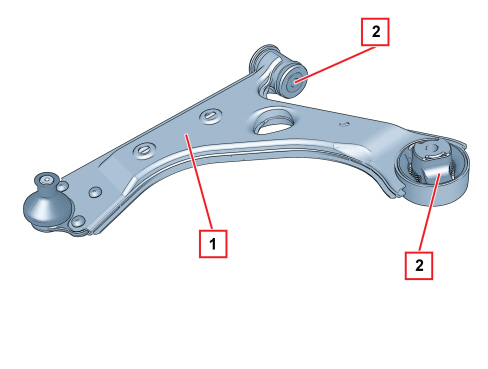
1. Track control arm
2. Flexible bushes
The track control arm is attached to the crossmember by flexible bushes press-fitted on the track control arm, whilst the ball joint for connection to the wheel strut is attached to the arm by riveting .
Special shock absorbers
Special, dual acting, telescopic, hydraulic shock absorbers fitted as standard on all versions.
These shock absorbers feature a spring, fitted inside the shock absorber, which acts during the extension in parallel to the main spring with the main aim of reducing roll.
The internal spring illustrated is located between the tube and the stem, secured to the upper end of the tube and acts on the shock absorber extension travel.
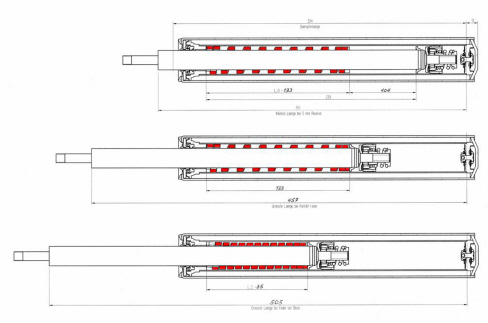
Depending on how long the spring is, the intervention start point, in parallel to the main suspension spring, changes.
Fixing the length of the internal spring and, consequently, its intervention point, establishes the driving condition in which the internal shock absorber spring starts to act and therefore contributes to the overall strength of the vehicle.
As a result, if the intervention point for the internal springs is properly established this means that in normal driving conditions the vehicle behaves conventionally whilst in sports driving conditions rigidity during roll is increased with benefits in terms of handling.
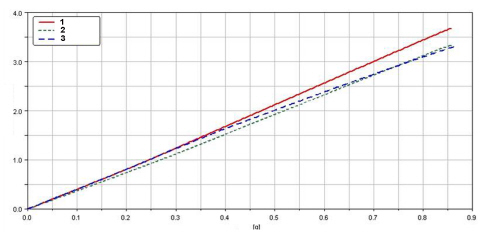
In this graph showing the roll angle dependent on lateral acceleration, for a conventional vehicle (1), a conventional vehicle with particularly rigid suspension (2) and a vehicle with special shock absorbers (3), this effect can be noticed. In particular, the vehicle equipped with special shock abosrbers behaves similar to the conventional vehicle with rigid suspension for high lateral acceleration values; at the same time, the special shock absorber internal springs do not intervene for low lateral acceleration values making it obvious that unlike the vehicle with rigid suspension, comfort is not adversely affected in non sports driving conditions.
A further aspect that should be mentioned is the fact that when the special shock absorber internal springs intervene when cornering, only the shock absosrbers for the inner wheels are working (extended) and not the shock absorbers for the outer wheels (compressed). In these circumstances this results in an asymmetrical configuration with a rigidity that alters the roll dynamics with two consequences:
- a more marked support on the outer wheels improving the grip of the tyres
- a lowering of the roll centres resulting in improved stability.
The turret mountings are the "split" type (dual-path) for improved filtering of road vibrations at the same time guaranteeing excellent structural strength favouring driving precision.
The strengthened and lowered coil springs with side-load are designed to improve thrust in order to reduce the tangential forces on the shock absorber stem and consequently internal friction resulting in improved absorption of slight road imperfections.
Anti-roll bar
The anti-roll bar is stiffened to better control vehicle roll with connecting hinges mounted on the shock absorbers, which allow improved stabilizing efficiency and better dynamic responsiveness when cornering.
The anti-roll bar is attached to the suspension crossmember by two flexible mountings.