SPECIFICATIONS
Two ductile cast iron, overhead camshafts in a camshaft housing; they are operated by a belt and gears.
COMPOSITION
The shafts incorporate appropriately positioned and profiled cams; one for each valve to be operated.
The exhaust shaft is prepared at the front for the fitting of the toothed pulley by means of which it receives movement from the crankshaft by means of the toothed belt.
A pair of gears, fitted at the behind the shafts, allows the transfer of power from the exhaust shaft to the inlet shaft.
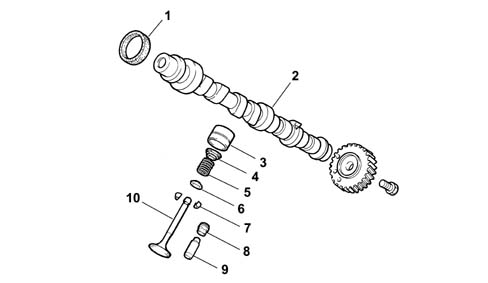
1, Camshaft oil seal
2, Camshaft
3, Tappet
4, Upper shim
5, Spring
6, Lower shim
7, Cotters
8, Oil seal
9, Valve guide
10, Valve
HYDRAULIC TAPPETS
The hydraulic tappets used on this engine type automatically take up valve clearance during engine service. This offers the advantage of reducing:
-
maintenance operations
-
engine noise.
Operation in open stage
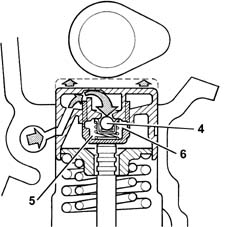
When the camshaft cam acts on the cup (1) and thus the piston (2), the oil trapped in the chamber (6) due to the closure of the ball valve (4) transmits the movement of the piston (2) directly to the hose (3) and consequently to the valve. At this stage, due to the high pressure acting on the oil, some of the oil in the chamber (6) leaks through the tiny gap between the piston (2) and the hose (3).
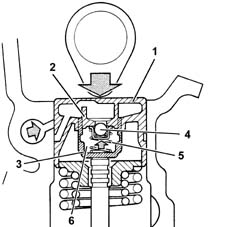
Operation in closed stage
During valve closure, as long as the tappet pressed by the action of the spring (5) follows the cam outline, a vacuum builds up inside the chamber (6), bringing about opening of the ball valve (4) to allow oil to enter. The oil taken into the chamber (6) replaces the oil that leaked out during valve opening.