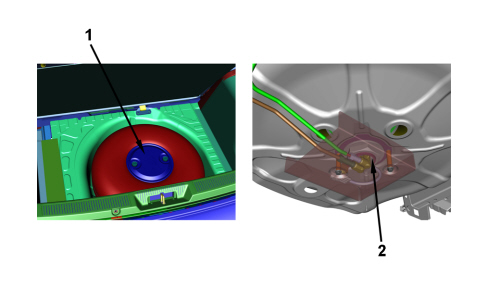
The multivalve is housed in the chamber inside the tank ring and is protected by a cover (1). Though it is sealed, this chamber is in contact with the outside environment through a lower opening (2) which, as laid down by the international regulations, allows the ventilation of the area around the valves thus preventing gas accumulation due to even small leaks from the valves.
No maintenance operations can be carried out the on the multivalve assembly.
The exception to this are the solenoid valve coil and the solenoid valve itself; all other operations must be entrusted to the tank supplier.
The solenoid valve is supplied by the LPG injection control unit.
When the solenoid valve is de-energised (engine off or running on petrol), the path to the pressure reduction until is closed.
With the solenoid energised (ignition key turned to MAR-ON and engine running on LPG) the path is opened to the pressure reduction unit, bringing the cylinder into communication with the engine fuel supply system.
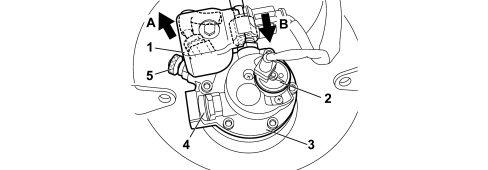
The functional assembly components are listed below:
-
a valve that automatically stops the refuelling of LPG when the maximum permitted filling level is reached (80% of the total tank capacity);
-
a flow limiter which, if a piping is broken, prevents the complete and sudden escape of LPG;
-
a check valve, located on the gas supply pipe to the tank (B), which prevents LPG counter flow;
-
a gas cut-off solenoid valve (1) on the LPG supply line for enabling or preventing the outflow of gas towards the pressure reduction unit;
-
a manual tap (5), positioned upstream of the solenoid valve (1) for maintenance operations;
-
a fuse pad (4) which, in the event of overheating (temperature above 120°C), totally eliminates the danger of excess pressure, releasing the LPG in the tank as quickly as possible in a controlled manner;
-
an analogue level gauge (3) for LPG in the tank, provided with an electrical connection to send the information to the LPG injection control unit.
-
A liquid LPG level gauge with float.

|
If this 80% valve is not working properly, the tank could become too full resulting in a dangerous increase of internal pressure. |

|
If the cylinder becomes too full when refilling with LPG (which, starting from a gas level of zero, means that the maximum quantity of 39 litres of LPG has been exceeded), replace the whole tank. The rated capacity of the tank is 48 litres, corresponding to a useful capacity of 38 litres. |
IN THE EVENT OF AN ACCIDENT
|
|
The main precautions are the same as for a car running on petrol. Always remember to engage the handbrake, switch off the engine (a safety device cutting off the gas flow to the engine is automatically activated), panel and lights and, if possible, isolate the tank closing the manual valve (4) on the LPG tank multivalve. |