This automatically increases the pressure in the braking circuit during emergency braking, thanks to a mechanical device - illustrated below - housed in the brake servo. During emergency braking, the device allows the section through which the outside air passes at atmospheric pressure to be rapidly increased, to act on the brake servo diaphragm thus increasing the braking force.
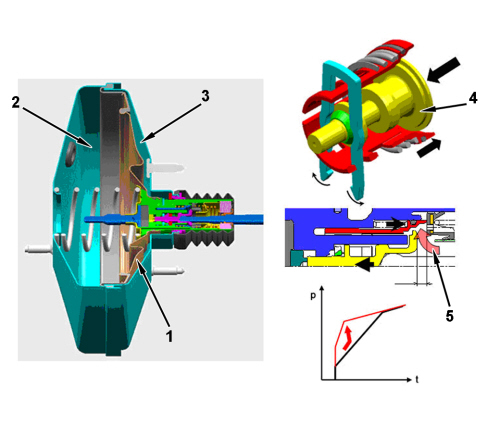
1. Mobile diaphragm
2. Chamber A
3. Chamber B
4. Valve with inertia control
5. Outside air flow during emergency
The braking force is amplified using a brake servo equipped with a mobile diaphragm (1) which separates chamber A (2), master cylinder side, from chamber B (3), brake pedal side.
When the brake pedal is released, vacuum is created in chambers A and B.
When the brake pedal is pressed, outside air enters and reaches chamber B; this air presses the mobile diaphragm and as a consequence the master cylinder plate. In this way the brake pedal braking force increases.
Standard braking:
the control rod and piston stop due to the back pressure generated in the master cylinder piston. The outside air flows towards chamber B through the open valve and presses the mobile diaphragm towards the master cylinder.
The reaction plate causes the valve piston to adhere to the valve head, preventing a further outside air from entering. In this way the braking force amplification is adjusted.
Panic braking:
the valve between the atmosphere and chamber B opens completely and creates atmospheric pressure in chamber B. The maximum power assistance force is thus obtained.
Therefore, in the event of sudden braking, the braking force will increase according to the amount of outside air entering chamber B.
To this purpose a "valve with inertia control" is used which is a component of the MBA braking assistance.
When the brake pedal operating speed exceeds a certain value, the valve with inertia control immediately opens the connection between chamber B and the atmosphere, as during panic braking, irrespective of the force applied to the brake pedal. The maximum pressure difference is created between chamber A and chamber B in a few fractions of a second, and the braking force is amplified to the maximum level until the ABS intervenes.