ALFA ROMEO CODE SYSTEM
The vehicles are equipped with an electronic system known as the ALFA ROMEO CODE to produce the engine immobilizer function.
The ALFA ROMEO CODE system only allows the engine to be started by means of the Engine Management Node (NCM) after a secret code, memorized previously in the NCM, is received.
The second generation Code system is incorporated in the Body Computer Node (NBC).
In addition to the Body Computer, which works as a control unit, the ALFA ROMEO CODE comprises the following components:
- CAN C line for dialogue between the NBC and the NCM
- Engine Management Node (NCM).
- electronic key containing a transponder with a secret code;
- an aerial that reads the code contained in the key transponder
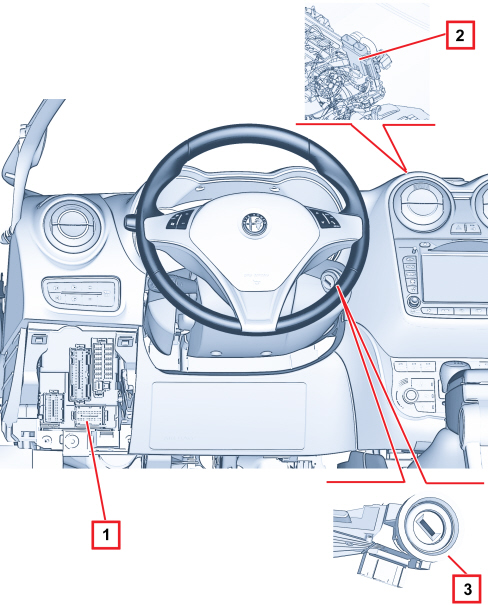
1 - Body Computer (NBC)
2 - Engine Management node (NCM)
3 - Aerial
Operation
The ALFA ROMEO CODE allows the start of engine management by the NCM by means of a coded dialogue between the NBC and NCM during the stage that precedes starting.
After the key is turned to the ON position, the NCM sends a code request to the NBC which only responds after having recognized (via the aerial) a known electronic key inserted in the ignition switch.
If the password provided is valid, the NCM continues with the regular engine management activities, allowing the engine to be started up.
The NCM can only memorize the secret code through a special procedure.
Interaction between the alfa romeo code and the key
Each key contains a transponder with a PASSWORD.
As soon as the key is turned ON, the transponder converses with the NBC which, having recognized it as one of the enabled ones, continues with the NCM recognition strategy.
If the identification code is not recognized, the procedure is aborted and the engine cannot be started.
The recognition of the PASSWORD takes place by means of a challenge-response algorithm with the exchange of an encrypted code. The code recognition time is a maximum of 160 ms per attempt.
The ALFA ROMEO CODE attempts the transponder acquisition for up to 1.3 seconds.
Communication between engine control node and alfa romeo code node
The dialogue between the ALFA ROMEO CODE (NBC) and the NCM control units takes place via the CAN.
Every exchange of information between the ALFA ROMEO CODE and the NCM is guided by the NCM (the NBC never interrogates the NCM but only responds after a request).
After KEY-ON, the flow of code exchange operations between the NBC and the NCM depends on the status (blank or memorized) of the NCM.
If the NCM is blank, the procedure involves sending the secret code request to the NBC: in this way the NCM learns the password and stores it in its memory. This procedure is known as CODE RECORDING.
If the NCM has already been programmed, the procedure involves checking that the codes stored in the engine management control unit memory and the one memorized in the NBC correspond:
This procedure is known as CODE VERIFY.
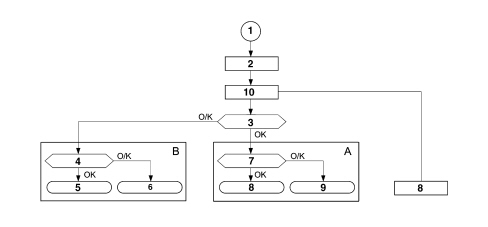
1 - Key on
2 - NCM initialisation
10- FLGOPT = 1 ?
3 - NCM status memorized OK, pristine NOT OK
A - CODE VERIFY
7 - Is the password valid?
8 - the operation of the engine is allowed
9 engine operation is not allowed
B - CODE RECORDING
4 - Memorization successfully completed?
5 - the operation of the engine is allowed
6 - the operation of the engine is not allowed
Code recording
The CODE RECORDING procedure is the memorizing of the passwords in the engine control unit.
Only after the NBC has memorized the identification codes and the passwords, is the NBC ready to satisfy the request to transmit a code to a blank NCM.
After a key on, the engine management unit initializes its software and requests the password if it is blank.
If the NBC is not blank, it responds by sending the passwords, but only after having recognized an authorized key. If the key is not authorized (unrecognized) or there is no key, the NBC does not respond.
If the NBC is blank and there is no transponder in the key and a request is sent for passwords from the NCM, the NBC does not respond.
Code verify
This is the standard procedure that is repeated during the life of the vehicle each time the user inserts the key in the ignition and turns it ON: this procedure enables the starting of the engine if the key inserted is enabled.
If it is not completed, the code verify procedure continues even when the user turns the key to the AVV position.
After the key is in the ON position, the NBC recognizes whether the transponder in the key is one of those that is enabled.
At the same time, with the key in the ON (MAR) or starting (AVV) position, the NCM initializes its software to check whether the passwords have been memorized. If the answer is yes, it sends a request to the NBC.
If the result of the transponder recognition is negative (incorrect transponder, no transponder in the key, etc.), the NBC will send a negative authorization response to the engine management control unit.
In response to this request, it only sends the secret encrypted codes to the engine management control unit if the transponder is recognized as enabled.
If the NBC is blank and the NCM sends a request for the passwords, the NBC, after having recognized the presence of a recognized transponder, responds by sending a positive authorization reply.
Communication via the can
Communication via the Body Computer and the NCM takes place via the following two CAN messages:
- immo code request (sent by the NCM and received by the NBC)
- immo code response (sent by the NBC and received by the NCM)
Protection codes
The protection codes used by the NBC and NCM are listed below
- UNIVERSAL CODE: this is the code that a blank NBC sends to the NCM when it detects the presence of a transponder in the key. The vehicle protection warning light comes on at a frequency of 1.6 Hz and 50% duty cycle. The flashing of the warning light explains that the system is connected and working properly, but the vehicle is not protected by a code.
- PASSWORDS: these are the codes in the transponder. They are is stored in the transponders contained in the keys when the transponders are programmed and in the NBC when the keys are programmed at the end of line.
- ELECTRONIC CODE (PIN): this is printed on the CODE CARD, which is given to the vehicle owner. It takes the form of a 5-figure decimal code (0 is not permitted). It is used to access the NBC memory in protected mode in order to reprogram or program new remote control keys and/or perform specific diagnostic functions.
- IDENTIFIER: This is resident in the transponder and different for each transponder. It is stored in the NBC during the programming procedure. The NBC manages a table of enabled identifiers and another table of disabled identifiers.
Body computer
The ALFA ROMEO CODE is a function inside the Body Computer Node (NBC).
The main ALFA ROMEO CODE functions are:
- recognizing the introduction and rotation of a key in the ignition (ON);
- conversing with the key transponder by means of the immobilizer aerial;
- storing up to 8 identification codes;
- memorizing the passwords;
- managing a list of 4 permanently disabled identifiers;
- managing the CAN line towards the engine management control unit;
- managing the activation of the warning light on the panel via communication with the instrument panel;
- carrying out the autodiagnosis for the CODE system functions.
ALFA ROMEO CODE supply as spare part:
If the ALFA ROMEO CODE function has to be replaced, the entire Body Computer must be replaced. To replace the Body Computer, request it from the Parts Dept., providing the vehicle chassis number as illustrated below.
Aerial
The aerial assembly comprises a toroidal aerial with a connector built into the aerial body.
The wiring connected to the NBC is incorporated in the dashboard cable loom
The aerial is supplied with power by the NBC to energize the key transponder.
Since the aerial needs to be as close as possible to the transponder (on account of electro-magnetic immunity, the limited range of the transponder and small dimensions) it is fastened axially to the ignition switch.
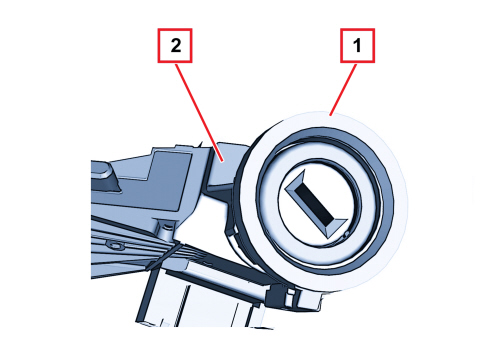
1 - CODE aerial
2 - Ignition switch
Ignition key
The mechanical key contains a cipher transponder in the grip.
The moment the key is inserted in the ignition and turned to the ON position, the transponder is energized by the aerial and responds by emitting the rolling, encrypted secret code.
If the code is recognized as valid, the NBC sends the engine control unit, on request, a coded signal allowing the engine to be started.
Up to 8 keys can be programmed in the NBC

|
The keys are supplied already programmed by the production plant. All the codes are also stored in a database managed by the Parts Dept. When the new vehicle is delivered to the customer, the service network does not need to carry out any memorisation procedure. If the keys are mislaid or additional keys are required, make the request to the Parts Dept. as described in |
Transponder in the key
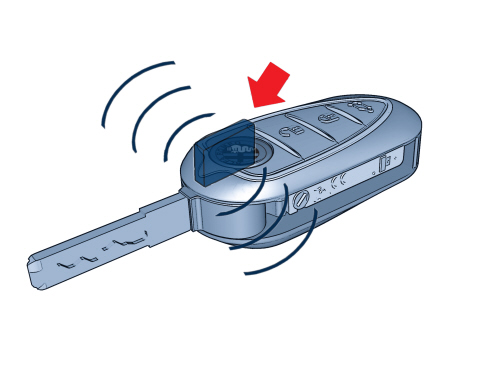
The transponder in the key has the following stored in its memory:
- PASSWORD;
- IDENTIFIER which is different for each transponder produced;
- PROGRAMMING DATA for the password.
The identification code differs from transponder to transponder to guarantee that no two transponders have the same identification code even if there is a request for a duplicate in the Network.
Reprogramming keys
Reprogramming the keys involves storing the keys enabled upon vehicle start-up in the NBC.
Both the new keys to be programmed and those already programmed are inserted into the ignition to be recognized by the NBC: this memorizes the keys presented during the procedure in the enabled identification codes tables and transfers those no longer presented to the disabled identification codes table.
Disabled keys table
If an enabled key is no longer available (mislaid, stolen or no longer working), the subsequent key programming procedure (in which the key is no longer presented) disables its operation.
The NBC manages a table in the EEPROM that can contain data on 4 disabled keys: the identifiers of enabled keys not presented during the reprogramming procedure are transferred to this table.
If the disabled keys table is full, any new key will replace the first entered in the table.
This table also allows keys used on the vehicle to be traced.
Key reprogramming procedure
The key reprogramming procedure is performed/guided by the EXAMINER Diagnostic Equipment: this procedure is activated by means of access protected by the vehicle PIN.
Continue by following the instructions on the diagnostic instrument/EXAMINER.
It is possible to programme up to 8 enabled keys.
Deleting a lost key from the memory
At any time it is possible to delete a lost key from the memory using the EXAMINER Diagnostic Equipment. The identifier of this key is transferred to the disabled identifier table and will no longer be recognised.
Code card
This card shows:
- The emergency code (electronic code) that allows the Service Network to programme electronic keys (Tags) and remote controls using an EXAMINER.
- The emergency key mechanical code identifies the mechanical profile of the key and must be specified on the order to receive the key already cut.
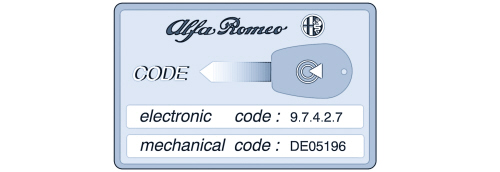
Operation
The electronic emergency code is also used for system diagnosis and for other operations using Examiner or other diagnostic instruments. Many of these operations (e.g. key programming) can be carried out only once this code has been entered.
Before any operation, it is therefore necessary to ask the Customer for their Code Card.

|
The Code Card must not be left in the vehicle in case it is stolen. |
Vehicle protection warning light
The vehicle protection warning light is located in the instrument panel and is controlled by a message from the NBC on the B-CAN.
Operating mode and vehicle protection warning light flashing time
The NBC controls the switching on of the vehicle protection warning light in the panel, via the CAN, flashing in order to signal programming errors for the Body Computer or the NCM.

Fault diagnosis
The ALFA ROMEO CODE function allows self-diagnosis to be carried out for system components.
The NBC is capable of identifying and memorizing the presence of the following malfunctions in its EEPROM:
Transponder:
- defective or missing transponder or password incorrect
- deleted/disabled
- unknown/not memorized
Transponder aerial:
- electrical connection defective (open circuit, short circuit to earth or to battery)