COMPOSITION
The vehicle exterior lighting system has been designed and produced with two objectives in mind:
- guaranteeing maximum efficiency with regard to the international regulations that define the lighting technology specifications for the various components;
- being integrated with the design of the vehicle so that the various components enhance the image.
Location of components on vehicle
The vehicle components and their location are illustrated below.
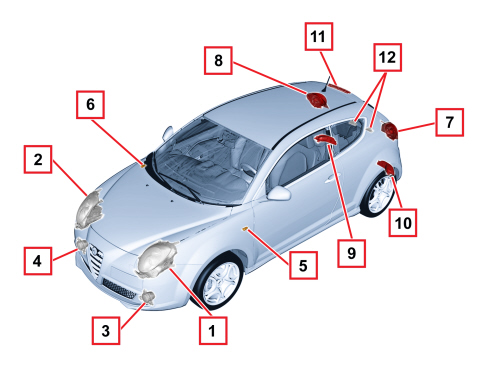
1 - LH front light cluster
2 - Right front light cluster
3 - Left fog light
4 - Right fog light
5 - Left front direction indicator
6 - Right front direction indicator
7 - Left tail-light cluster
8 - Right rear light cluster
9 - Reversing light
10 - Rear fog lamp
11 - Centre rear brake light (third brake light)
12 - Number plate lights
Operation
Daytime running lights (d.r.l.)
With the key in the ON position and the ring nut in position "O" the daytime lights come on automatically; the other lights and the interior lighting remain off.
For day light functions, see the "Menu Items" paragraph in this chapter.
If the DRL function is off (instrument panel setup menu), no light will come on when the ring is turned to the "O" position.
When the day lights are switched on, the Body Computer will power the two lamps (right and left) arranged in the front headlights.
Each day light bulb is diagnosed. A "day light failure" indication will be indicated by the Body Computer if a bulb fault is found.
Side lights
With the ignition key at MAR, when the steering stalk ring nut is turned to the "dipped beams" position, the daytime lights go out and the side lights and dipped headlamps are turned on.
The corresponding warning lights light up on the instrument panel.
When the day lights are switched on, the Body Computer powers the four lamps (right/left, front/rear).
At key-on, the side lights are always switched on with the dipped beam lights.
All side lights will be supplied for the necessary time when the "Follow Me Home" function is on.
At key-off, the "courtesy light function" will switch on the rear side lights for a certain time when the doors or tailgate are opened using the remote control.
Diagnosis is performed for each lamp. A "side light fault" indication is indicated by the Body Computer when a bulb fault is found.
Number plate lights
The two external number plate lights light up when the side lights are switched on.
At key-off, the "courtesy light function" will switch on the number plate lights for a certain time when the doors or tailgate are opened using the remote control.
Each number plate is diagnosed and a number plate light failure indicator is present on the instrument panel.
Parking lights
This function is used to switch on the side lights and the number plate lights at key-off to indicate the presence of the parked vehicle.
The function (at key-off only) is obtained by turning the ring on the left stalk from the "O" position to the "dipped beam" position. To switch the function off, turn the ring from the "dipped beam" position to the "O" position.
At key-on, the "parking light" function is deactivated and cancelled. The side lights and number plate lights are switched off and may be switched on automatically by the dusk sensor (where fitted). The function will not be reactivated at the next key-off. Repeat the procedure to reactivate the sequence.
Dipped headlamps
With the ignition key at MAR, when the steering stalk ring nut is turned to the "dipped beams" position, the daytime lights go out and the side lights and dipped headlamps are turned on.
The corresponding warning lights light up on the instrument panel.
When the dipped beam lights are switched on, the body computer actuates the relay which powers the lamps.
At key-on, the dipped beam lights are always switched on with the side lights.
Within a certain time from key-off, the "Follow Me Home" function for switching on the dipped beam lights for a certain time.
Furthermore, at key-off, the "courtesy light function" will switch on the dipped beam lights for a certain time when the doors or tailgate are opened using the remote control.
External light operation by dusk sensor
At key-on, the dusk sensor informs the Body Computer via LIN serial network of the environmental light conditions both if the ring on the left stalk is turned to the "Auto" position or if the function is not active.
The sensor is activated when the ring of the left stalk is taken to the "Auto" position, the instrument panel shows the last set light sensitivity value and the user can set a new one.
After sensor activation, sensitivity can be changed by the user by means of the instrument panel setup menu. The body computer switches the external lights on and off according to the environmental light data it receives from the sensor. The day lights are switched on if there is more light; otherwise, the side lights, the instrument panel warning light, the number plate lights and the dipped beam headlights are switched on.
A "dusk sensor failure" indicator will appear on the instrument panel if a dusk sensor fault is detected. The side lights along with the panel warning light, the number plate lights and the dipped beam headlights appear if the stalk ring is turned to the "Auto" position.
Follow me home
The “Follow Me Home” function lights up the side lights and dipped beam headlights immediately after stopping the vehicle and for a certain time.
The function can be activated within 2 minutes from key-off using the steering column stalk flasher control.
After the function has been activated and the side lights and dipped beam headlights are on, each further flasher operation will increase the operation time by 30 seconds. The flasher control can be operated for up to 7 times for a total of 210 seconds of operation.
The “Follow Me Home” function may be deactivated by holding the flasher for longer than 2 seconds. This control will only apply if the function is on and will switch the side lights and dipped beam headlights off and will reset the lights on timer and the 7 control counter.
The “Follow Me Home” can be switched on again after having been switched off by using the flasher stalk within 2 minutes from key-off.
NB. The Follow Me Home will be deactivated when switching from key-off to key-on.
The Follow Me Home function will be deactivated and the side lights and dipped beam headlights will go out after the timeout.
Direction indicators/hazard warning lights
At key-on, the Body Computer controls the direction indicators according to how the left steering stalk is operated.
The direction indicators on one side only of the car will be operated according to the control (either left front, side and rear indicators or right left front, side and rear indicators).
A tone will be heard in the passenger compartment at the same time.
When the lever is returned to the rest position, the lights and the other direction indicators go out.
If the direction indicators are on, they go out at the key-off.
When the hazard lights are operated, at key-on or key-off, the Body Computer operates each 6 direction indicator (front, side, rear, left and right) and activates the tone in the passenger compartment.
If the hazard light switch is operate while the indicators on one side of the car are on, the indicators will continue to blink without interruptions or delays.
If a fault is detected with one of the front or rear direction indicator bulbs, on the side of the vehicle selected for the Direction indicators function or for the Hazard warning lights function, at the same time as the failure indication comes on, the flashing frequency of the visual display and acoustic signal are increased.
NB. The flashing frequency of the exterior lights remains unchanged.
The direction indicators are also used by the vehicle access system while operates them in priority manner for indicating locking and unlocking using the remote control.
The direction indicators can be operated by the alarm control unit for indicating situation of danger via the Body Computer.
The Body Computer will operate the direction indicator also in case of emergency braking and activation of the Fire Protection strategy.
Rear fog lamp
The rear fog light is switched off when the "rear fog light" button is pressed providing the side lights and dipped beam headlights are on. The light is switched off by pressing the same button or switching off the side light and dipped beam headlights.
The corresponding indication will appear on the panel when the rear fog light is switched on.
If the fog light is on at key-off, it will not be switched on at the following key-on. The Body Computer carries out the following fault diagnosis for the rear fog lamp bulb: when a fault with the bulb is recognized, the corresponding "rear fog lamp failure" signal is activated.
Fog lights
The rear fog light is switched off when the "rear fog light" button is pressed providing the side lights and dipped beam headlights are on. The light is switched off by pressing the same button or switching off the side light and dipped beam headlights.
If the fog lights are switched off when the side lights and dipped beam headlights were switched off, the fog lights will not be switched back on when the side lights and dipped beam headlights are switched on. The fog lights can be switched on by pressing the button after switching on the side lights and the dipped beam headlights.
The corresponding indication will appear on the panel when the fog light is switched on.
If the fog lights are on at key-off, the will not be switched on at the following key-on.
The fog lights will be switched off while cranking the engine but the control is not reset in this case.
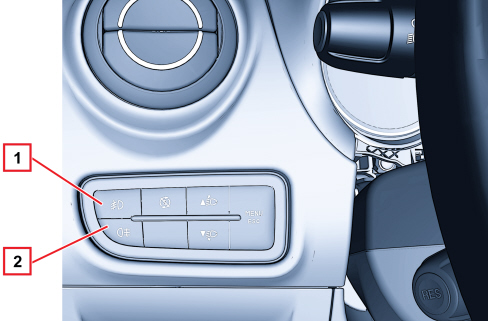
1- Fog lights control
2 - Rear fog lamps control
Front light cluster (basic version - not gas discharge)
The unit consists of:
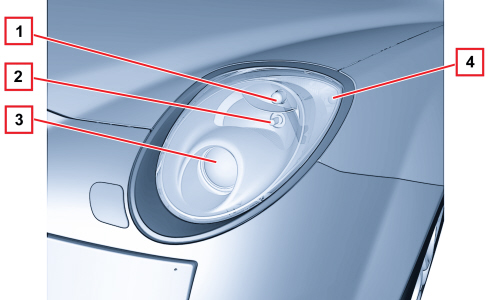
1 - Side/day light
2 - Main beam headlamp
3 - Dipped headlamp
4 - Direction indicator
Bulbs present:
- Halogen H1 55W - 12V for main beams function
- H7 55W - 12V longlife halogen for dipped headlamps function
- WY21W -12V bayonet for direction indicators
- All glass W21/5W -12V for side/day lights function
Rear view and connector
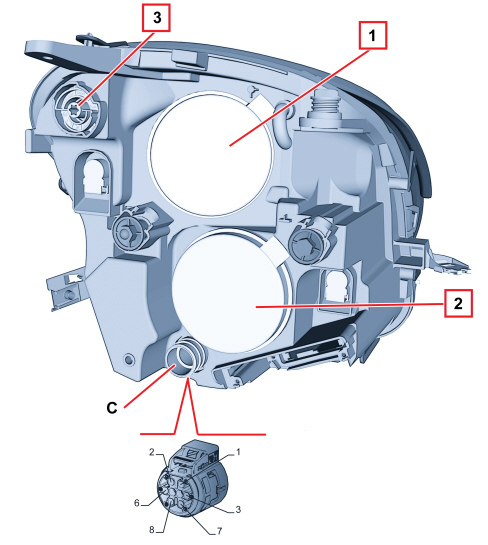
1 - Dipped beam and side/day light lid
2 - Dipped headlamps lid
3 - Direction indicators lid
C: connector
CONNECTOR PINOUT:
1 - Main beam headlamps control
2 - Side lights control
3 - Direction indicators control
4- Dipped headlamps control
5 - Earth connection
6 - Power supply for headlamp alignment corrector
7 - Headlamp alignment correction signal
8 - Day light control
Electrically controlled headlamp alignment corrector

|
For gas discharge versions, see below |
The headlamp alignment device is designed to adjust dipped light beam correctly in a vertical direction irrespective of the load on the axles.
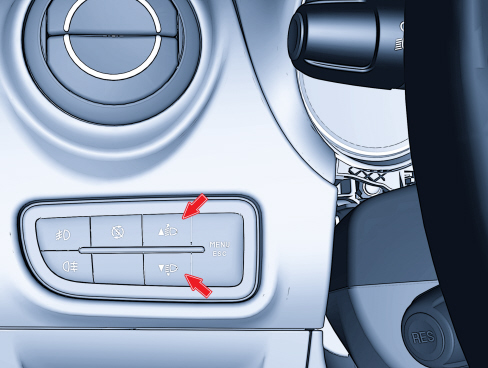
With the dipped headlamps on, using the buttons in the controls on the left of the dashboard, it is possible to alter the angle/direction of the light cluster in 4 standard positions: the following loads correspond to the four positions:
- 0: 1 person (driver), 2 persons (in the front seats)
- 1: 5 persons, 2 persons (in the front seats), 3 persons (in the rear seats)
- 2: 5 persons plus maximum load
- 3: 1 person (driver) plus maximum permitted load in luggage compartment without backrest folded down
The maximum load refers to: the maximum permitted load on the rear axle or: the total permitted load for the vehicle. The weight of a person is taken as 75 kg.
The instrument panel display shows the position in relation to the adjustment set.
See descriptions 5560 INSTRUMENTS
The headlamp incorporates an electric motor: the latter controls the position by means of a pinion and an adjustment screw suitably tilting the dipped headlamp reflector.
Rear light clusters
The rear light clusters contain the following:
- brake light;
- direction indicator;
- side light.
The unit in the bumper contains:
- Red rear fog lamp (on the driver's side).
- White reversing light (on the passenger side).
Side lights
Led lights
LEDS (light emitting diodes) are used for the main rear light cluster functions.
This ensures compact size and light weight in addition to low consumption and high light efficiency (LEDs consume up to 60% less than traditionally light bulbs and to heat up).
Furthermore, they lack the traditional filament, which is the part most subject to breakage. For this reason, they are totally shock-resistant and guarantee a duration of 100,000 hours of operation, against the 3-5,000 hours of a traditional light bulb, which is considerably longer than the average vehicle life.
Other features include better visibility, faster response times beneficial for example for brake lights to warn other drivers (LEDs light up quicker, in 1 thousandth of a second inside of 200). This allows the driver of the following vehicle to see the braking more in advance and gain a space of approximately 5 metres at 120 km/h.
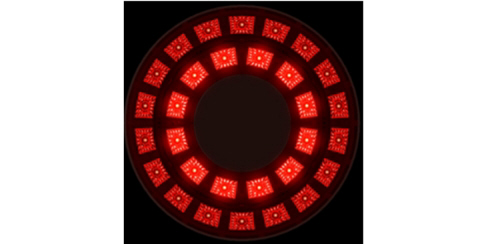
In the example, the "crown" of LEDS of the rear/brake lights.
Rear view and connector
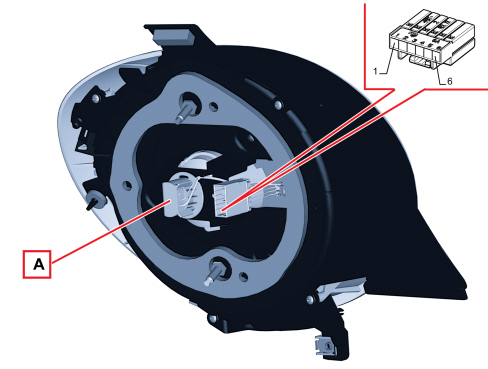
A: direction indicator lid
CONNECTOR PINOUT:
1 - Side lights control
2 - Side lights and brake light feed back signal
3 - Brake light control
4 - Direction indicators control
5 - Earth connection
Bumper lights
The two symmetrical units located in the bumper contain the red rear fog lamp P21W - 12V (driver's side) and the white reversing light P21W - 12W (passenger side).
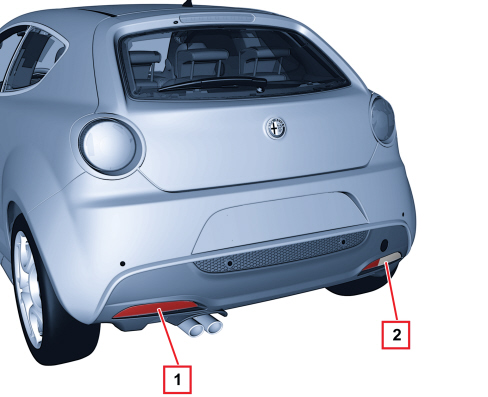
1 - rear fog lamp
2 - reversing light
Number plate light
The number plate light function is achieved by means of two light clusters fitted using a metal clip and a reference fastened to the panel.
Each lamp has a W5W (12V - 5W) all glass bulb
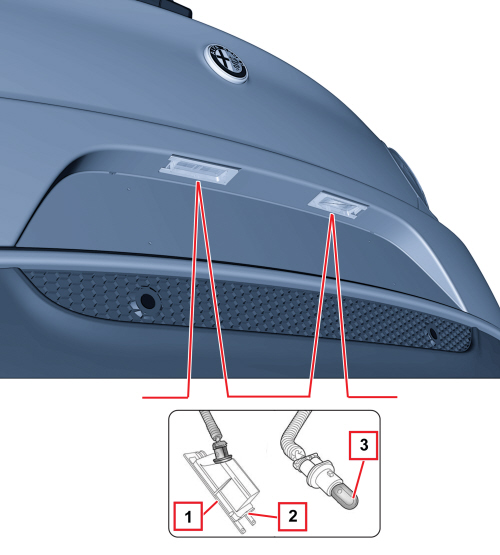
1 - Lens cover
2 - Clip
3 - All glass bulb
Direction indicators side repeater
To replace the small bulb, push the lens cover manually in the direction of travel in order to compress the fastening clip (5). Release the front section and extract the unit. Rotate the bulb holder in an anti-clockwise direction and extract it from the lens cover.
The bulb is orange and is the all glass type W5W (12V - 5W).
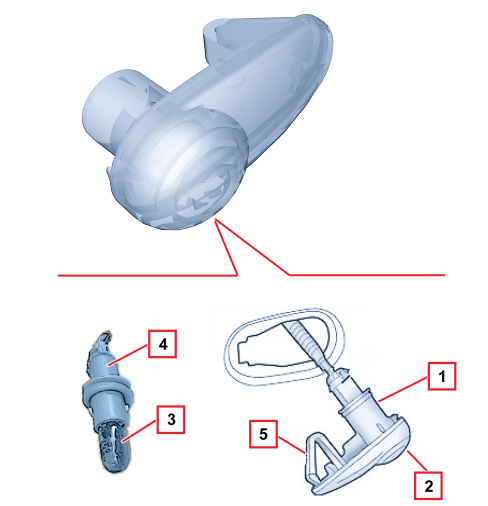
1 - Grey casing
2 - Lens cover
3 - All glass bulb
4 - Bulb holder
5 - Fastening clip
Additional (third) brake light
The additional brake light function consists of an electronic LED device and is arranged over the rear window serigraphy.
The grey body contains the LED device made in a single part and snapped onto the structure of the tailgate.
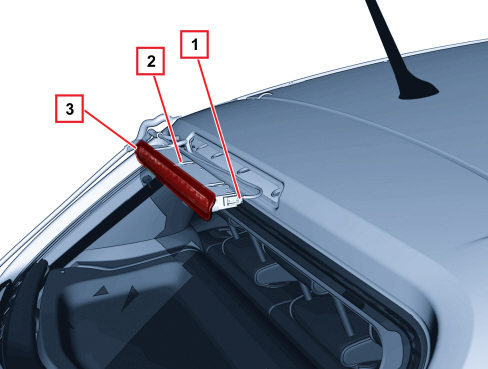
1- Connector
2 - LED unit
3 - (Red) lens cover
Fog lights
The fog lights are located in the lower part of the front bumper. The unit has a screw for adjusting the direction of the light beam.
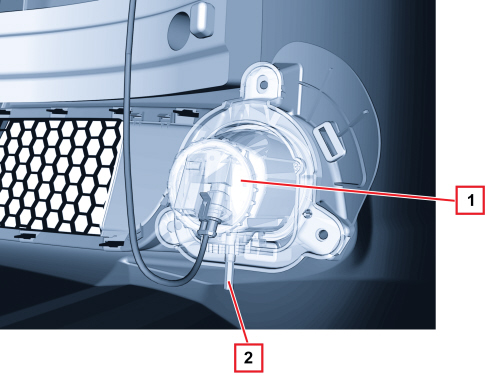
1 - Lamp casing
2 - Adjustment screw
The bulb used for the fog light function is a halogen H1 55W - 12V.