




|





|
|
| Service News | ||
|
|
Various models
Versions: All models |
|
|||
| 4410 0 000 AA |
FRONT-REAR SHOCK ABSORBERS
Hydraulic oil bleeds/leaks - Network Information |
|||

|
Cancels and replaces SN 44.01.15 for Fiat Freemont and Lancia Thema, Voyager and Flavia models |
CLAIMED FAULT
Hydraulic oil bleeds/leaks from one or both front / rear shock absorbers.
Oil fouling on front / rear shock absorbers and/or surrounding components.
GENERAL INFORMATION
The shock absorber rod gasket is designed to allow a small amount of oil to pass, in order to lubricate the rod and prevent wear of the gasket itself.
More or less noticeable amounts of marks/smears on the shock absorber do not necessarily indicate oil leak problems.
More often than not, marks/smears indicate seepage; if there is a leak, very noticeable drips will be visible on the shock absorber.
Seepage does not impair the component's performance, but an oil leak does do so.
Therefore, unless the Customer complaints of an obvious fault (shock absorber failure, impairment of car performance, etc.), the procedure described below should be adopted.
OPERATION CYCLE
Perform a visual inspection to ensure that the fouling is NOT caused by external sources (fuel, engine fluids, external contaminants, etc.).
If the oil comes from the shock absorber, proceed as follows:
- Clean the component.
- Perform an on-road test drive (choose roads which stress the shock absorber).
- Check visually for oil on the shock absorber.
- If no oil leaks are found DO NOT replace the component.
- If oil leaks are found, check their extent then proceed as described in table 1 below.
|
|
If appropriate, agreement should be reached with the Customer to check the component which is the subject of the complaint after about 1000 km. |
Table 1
|
Detected condition |
Operation |
|
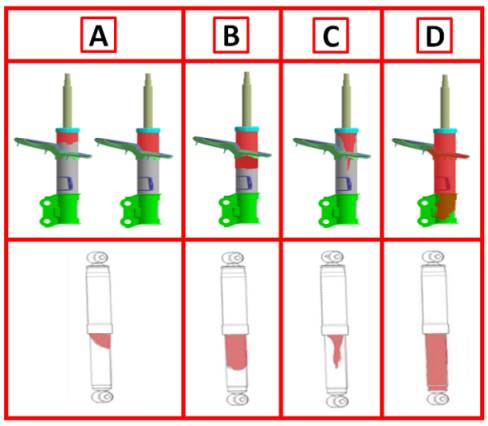
Slight or minimal oil leak WITHOUT loss of performance and/or obvious signs of failures (A and B – Fig.1) |
DO NOT replace any components |
|
Slight or minimal oil leak/drips WITH loss of performance and/or obvious signs of failures (A and B – Fig.1) |
Replace the component |
|
Oil drips or large amounts of oil WITH or WITHOUT loss of performance and/or obvious signs of failures (C and D – Fig.1) |
Replace the component |
Fig. 1