





|






|
|
| Service News | ||
|
|
Alfa Various Models
All models with Start&Stop - Giulietta, MiTo |
|
|||
| 0000 0 000 AA |
START&STOP SYSTEM
Engine stop/start system - Network Information |
|||

|
Cancels and replaces SN 00.13.10 of 05/11/2010 for the addition of new operation logics. |
The above models, both as standard production or upon demand, can be fitted with the engine stopping/starting system, called Start&Stop.
A short description of the system main features follows.
|
|
On some models, new operating logics were added; at the bottom of this document you will find the list of the models involved, the introduction chassis and the description of the new logics. |
START&STOP SYSTEM PURPOSE
The system was designed to contribute to consumption and (CO2) emission reduction; it operates whenever the engine is started and automatically stops the engine each time the car is stationary and restarts it when the driver wants to resume driving.
The efficiency of the car is increased, by reducing consumption, dangerous gas emissions and noise.
MANUAL ACTIVATION AND DEACTIVATION
The system can be activated/deactivated by a suitable button on the dashboard (see the Owner Handbook for the location).
|
|
If the climate comfort is to be favoured, the Start&Stop system can be deactivated, for a continuous operation of the climate control system. |
The system deactivation is signalled by the switching on of the warning light shown in Fig. 1.
Fig. 1

Depending on the models and versions, the warning light can be placed in the instrument panel or shown on the multifunction display.
MAIN OPERATING MODES OF THE START&STOP SYSTEM
STOPPING THE ENGINE
Cars with manual gearbox
With car at a standstill, the engine stops with gearbox in neutral and released clutch pedal.
Cars with TCT
The engine switches off if the gearshift lever is in a position other than R. The Start&Stop system does not operate when the gear lever is in R, for making parking manoeuvres easier.
|
|
The engine can only be stopped automatically over about 10 km/h, to prevent the engine from being repeatedly stopped when driving at walking pace. The engine stopping is signalled by the displaying of the symbol shown in Fig. 2. |
Fig. 2

RESTARTING THE ENGINE
Cars with manual gearbox
The engine is restarted pressing the clutch pedal.
Cars with TCT
The engine restarts automatically if:
- the brake pedal is released and the lever is not at N or P;
- the lever is shifted to an unstable position: (+), (−) or R;
- the lever is moved from D to the left in sequential mode;
- by the levers (+) or (–) on the steering wheel (for versions/markets where provided).
FAILED ENGINE STOPPING
The engine does not stop in special conditions, such as:
- engine still cold;
- especially cold outside temperature;
- battery not sufficiently charged;
- heated rear window activated;
- windscreen wipers working at maximum speed;
- particulate filter regeneration (DPF) in progress (diesel engines only);
- driver's door not shut;
- driver's seat belt not fastened;
- reverse gear engaged (for example, for parking manoeuvres);
- automatic climate control, if a suitable thermal comfort level has not yet been reached or MAX-DEF function activation;
- during the first period of use, to initialise the system.
In the above cases, the warning light (Fig. 2) in the instrument panel flashes or (where provided) an information message is shown on the multifunction display.
CONDITIONS FOR ENGINE AUTOMATIC RESTARTING
Due to emission control and safety reasons, the engine can restart automatically without any action by the driver, under special conditions, such as:
- battery not sufficiently charged;
- windscreen wipers working at maximum speed;
- reduced braking system vacuum (e.g. if the brake pedal is pressed repeatedly);
- car moving (e.g. when driving on roads with a gradient);
- stopping the engine through the Start&Stop system for more than about three minutes;
- automatic climate control system activated, for adjusting the thermal comfort level or MAX-DEF function activation.
|
|
In cases of undesired engine stops, due for example to the clutch pedal being released abruptly with a gear engaged, if the Start&Stop system is activated, the engine can be restarted by fully depressing the clutch pedal or by placing the gearshifting lever in neutral. |
SAFETY FUNCTIONS
When the Start&Stop system is activated, in engine cut-out conditions, if the driver unfastens his/her seat belt and/or opens the driver's door or the passenger door, the engine can only be restarted using the key.
This condition is reported to the driver by a buzzer, by the flashing of the warning light (Fig. 2) on the instrument panel or (where provided) by an information message on the multifunction display.
In case of cars equipped with Start&Stop system, to preserve the engine starter, the system does not allow the starter to work if the following conditions occur:
- ignition key operated.
- engaged gear
- clutch released
- brake pedal pressed
To move the car in emergency conditions, the system lets the starter to be operated if the following conditions occur:
- ignition key operated.
- engaged gear
- clutch released
ENERGY SAVING FUNCTION (for versions/markets where provided)
After the engine has been automatically restarted, if the driver does not take any action for a prolonged period (about 3 minutes), the Start&Stop system will definitively stop the engine to avoid fuel consumption.
In these cases, engine can be restarted only by the key.
|
|
In any case, it is possible to keep the engine running by deactivating the Start&Stop system. |
IRREGULAR OPERATION
In case of malfunctioning conditions, the Start&Stop system is automatically deactivated.
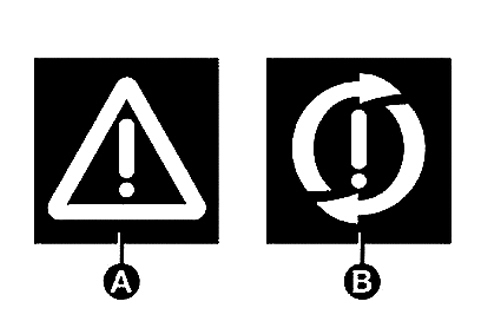
Depending on the versions, the driver is informed about the failure through the switching on of the warning light (A - Fig. 3) for general failure and, where provided, also by the warning light (B) for system failure in the instrument panel, or also through the flashing of the warning light (Fig. 2) on the instrument panel display, with a displayed message, too, on some versions.
Fig. 3

CAR INACTIVITY
In the case of car inactivity, special attention must be paid due to the disconnection of the battery power supply.
Cars with Start&Stop system having a dummy pole (for versions/markets, where provided)
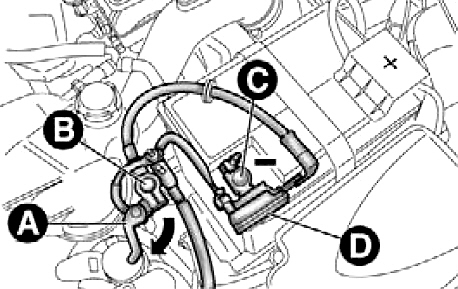
This procedure is carried out by disconnecting the quick release negative terminal (A - Fig. 4)
from the negative pole (B), because the negative pole (C) has a sensor (D) for battery conditions control.

|
The sensor (C) should never be disconnected from the pole except if the battery is replaced. |
Fig. 4
Cars with Start&Stop system without a dummy pole (for versions/markets, where provided)
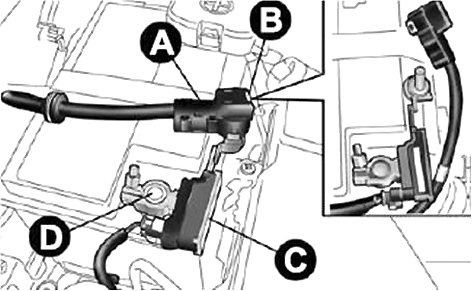
The procedure should be carried out by disconnecting the connector (A - Fig. 5 - by pressing the button B) from the sensor (C) for monitoring the battery conditions, installed on the negative battery pole (D).
|
|
The sensor (C) should never be disconnected from the pole except if the battery is replaced. |
Fig. 5
JUMP STARTING
Cars with Start&Stop system having a dummy pole (for versions/markets, where provided)
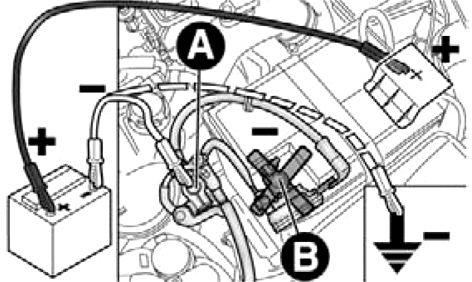
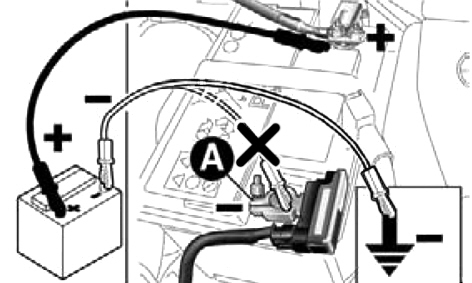
In the case of jump starting with a booster battery, never connect the negative lead (-) of the booster battery to the negative pole (B - Fig. 6) of the car battery, rather to either the dummy pole (A) or to an engine/gearbox earth point.
Fig. 6
Cars with Start&Stop system without a dummy pole (for versions/markets, where provided)
In the case of jump starting with a booster battery, never connect the negative lead (-) of the booster battery to the negative pole (A - Fig. 7) of the car battery, rather to an engine/gearbox earth point.
Fig. 7
START&STOP SYSTEM – NEW OPERATING LOGICS
The models and the relevant chassis numbers listed here below are those with the new Start&Stop system activation/deactivation logics implemented, according to the relevant table.
- MiTo - from chassis no. 1204418
- Giulietta - from chassis no. 7189652
|
Function |
Pre-modification |
After-modification |
|
Memorisation of the Start&Stop system status when the engine is switched off |
After each engine starting, the Start&Stop system is always activated even if it had been deactivated before switching the engine off. |
After each engine starting, the Start&Stop system will keep the same status (activated or deactivated) it had before the last switching off. |
|
Elimination of the Start&Stop system deactivation when the heated rear window is on |
the Start&Stop system deactivates when the heated rear window is activated. |
the Start&Stop system will be activated even if the heated rear window is switched on. |
|
Elimination of the Start&Stop system deactivation when the window wiper is at max. speed |
the Start&Stop system deactivates when the windscreen wiper max. speed is selected. |
the Start&Stop system will be activated even at the max. windscreen wiper speed. |
|
Decrease of the operation time of the Start&Stop button deactivation |
to deactivate the Start&Stop system the relevant button must be pressed for at least 300 ms. |
to deactivate the Start&Stop system just press the relevant button for at least 50 ms. |