





|






|
|
| Service News | ||
|
|
Alfa MiTo
All models with Start&Stop |
|
|||
| 0000 0 000 AA |
START&STOP
New engine stop/start system - Network Information |
|||

|
On MiTo 1.4 Turbo MultiAir 135 HP (for versions/markets where provided) and on other engines and models of the Group, on request, the vehicles will be fitted with the new engine stop/start system known as Start&Stop designed to reduce consumption and harmful gas (CO2) emissions, as well as noise pollution.
The Start&Stop device automatically stops the engine each time the vehicle is stationary and starts it again when the driver is about to engage a gear.
The device is activated every time the car is started up.
System description
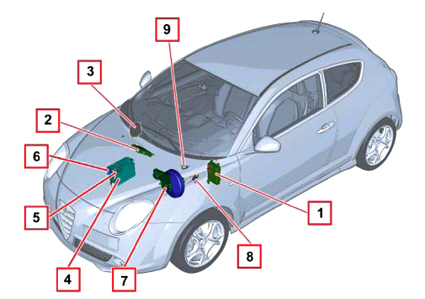
The Start&Stop system (whose main components are described in Fig. 1) stops the engine automatically when traffic conditions involve the car stopping; it restarts the engine when the driver wants to resume driving.
Start&Stop is essentially based on a starting system (battery and starter) capable of restarting the engine quickly and relatively quietly and can do this a far greater number of times than a standard (mass-produced) system would need to.
The system contains hardware and software components that manage the stopping and restarting operations without requiring the driver to change driving style, ensuring the safety, driveability and energy balance aspects of the vehicle with the minimum impact on climate comfort and the accessibility of the on-board services.
Structure of the system
The engine stopping and starting activation and control strategies are in two main control units (Fig. 1):
1 - Body Computer (BC)
2 - Engine Management Node (NCM)
Controls, signals and information required for activating the system come from the NCM and BC control units through dedicated wiring or CAN network.
The two NCM and BC control units communicate continuously to establish whether the Start&Stop system "integrity" conditions exist and whether the system is activated or deactivated temporarily or permanently.
The NCM is the "master" control unit which controls the stopping and the restarting of the engine on the basis of the information, acquired through the CAN network, on the status of the vehicle and of the important components for the Start&Stop system.
The BC control unit gets information about the vehicle systems interacting with the Start&Stop system, which are not directly controlled by the NCM; further on, it communicates to the same NCM the activation or deactivation (temporary or permanent) to control: engine stopping; engine restarting request; or, if safety is at risk, forces the NCM to stop the engine permanently, so that the next restarting can be made only by rotating the key.
Fig. 1 (Start&Stop system main components)
Key
1. Body Computer (BC)
2. Engine Management Node (NCM)
3. Voltage stabilizer
4. Battery
5. Battery charge status sensor
6. Dummy negative battery terminal
7: Brake servo pressure sensor
8. Clutch pedal sensor
9. Gearbox neutral position sensor (mechanical gearbox)
Operating modes
The Start&Stop system operating modes are described here below.
Engine stopping mode
With car almost at a standstill (speed lower than 3 km/h for more than 0.5 seconds and released accelerator pedal), the engine stops if the following manoeuvres are made:
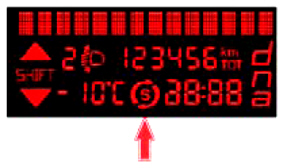
-gearbox in neutral-clutch pedal released | The engine can only be stopped automatically over about 10 km/h, to prevent the engine from being repeatedly stopped when driving at walking pace. Engine stopping is signalled by the warning light (S - Fig. 2) on the instrument panel display. |
Fig. 2
Engine restarting mode
Press the clutch pedal to allow the engine to be restarted.
Manual activation and deactivation
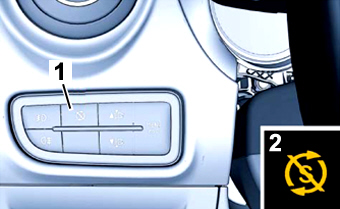
The Start&Stop system can be activated/deactivated by the button (1 - Fig. 3) on the dashboard trim, next to the steering wheel.
The system deactivation is signalled by the warning light (2 - Fig. 3) on the instrument panel display.
In addition, for versions/markets where provided, a message is displayed next to the symbol in case of system activation/deactivation.
Fig. 3
Missed engine stopping conditions
When the Start&Stop system is operating, due to comfort, emission control and safety reasons, the engine does not stop in some conditions, among which:
-engine still cold;-especially cold outside temperature,-battery not sufficiently charged;-heated rear windscreen activated;-windscreen wipers working at maximum speed;-particulate filter regeneration (DPF) in progress (diesel engines only);-driver''s door not shut;-driver''s seat belt not fastened;-reverse gear engaged (for example, for parking manoeuvres);-for versions equipped with dual zone automatic climate control (for versions/markets, where provided), if an adequate level of thermal comfort has not been reached or with MAX-DEF function activation;-during the first period of use, to initialise the system.In these cases, the display shows a message and - for those versions/markets where provide - the warning light (S - Fig.2) on the instrument panel display flashes.
Engine restarting conditions
Due to comfort, emission control and safety reasons, the engine can restart automatically without any action by the driver, under special conditions, such as:
-battery not sufficiently charged;-windscreen wipers working at maximum speed;-reduced braking system vacuum (e.g. if the brake pedal is pressed repeatedly);-car moving (e.g. when driving on roads with a gradient);-engine stopping by Start&Stop system for over 3 minutes;-for versions equipped with automatic climate control (for versions/markets where provided), to enable suitable thermal comfort or with MAX-DEF function activation.With engaged gear, the engine automatic restarting can occur only by fully pressing the clutch pedal; this action is required to the driver through a message on the instrument panel and, where provided, by the flashing of the warning light (S - Fig. 2), on the instrument panel
| When necessary, remind the driver that: - if the clutch is not pressed, after 3 minutes from the engine stopping, the engine can be restarted only by the ignition key. - in cases of unwished engine stops, due for example to the clutch pedal being released abruptly with a gear engaged, if the Start&Stop system is activated, the engine can be restarted by fully depressing the clutch pedal or by placing the gearshifting lever in neutral. |
Safety functions
Always remind the driver that, in engine stop conditions through the Start&Stop system, if the driver unfastens the seat belt and opens the driver''s door or the passenger door, the engine can only be restarted using the ignition key.
The driver is informed by a buzzer and through an information message in the display and, for versions/markets where provided, by the flashing of the warning light (S - Fig. 2) in the instrument panel.
"energy saving" function
(for versions/markets, where provided)
If, after the engine has been automatically restarted, the driver does not take any action for a period of about 3 minutes, the Start&Stop system will definitively stop the engine to avoid fuel consumption. In these cases, the start up of the
engine can be made only by the ignition key.
| In any case, it is possible to keep the engine running by deactivating the Start&Stop system. |
Irregular operation
In case of malfunctioning conditions, the Start&Stop system is deactivated.
The driver is informed about the failure through the switching-on of the warning light (general failure) on the instrument panel and - for versions/markets where provided - through the displaying of a message and a symbol.
Car inactivity
In case of vehicle inactivity conditions, pay special attention to the disconnection of the battery power supply.
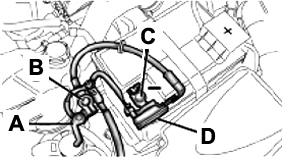
Always disconnect the quick-release negative terminal (A - Fig. 4) from the negative dummy pole (B) because the battery negative pole (C) has a sensor (D) monitoring the battery conditions, that should never be disconnected (unless the battery is replaced).
Fig. 4
Emergency starting
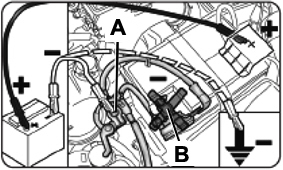
In the case of emergency starting with a booster battery (Fig. 5), never connect the negative lead (-) of the booster battery to the negative pole (B) of the car battery, but rather to either the dummy pole (A) or to an engine/gearbox earth point.
| If the climate comfort is to be favoured, the Start&Stop system can be deactivated, for a continuous operation of the climate control system. |
Fig. 5
OPERATIONS IN NETWORK
-For the routine P.D.I. operations, see SN 00.06.09.-Refer to SN 00.13.09 for Scheduled Maintenance Programme.-For general information, technical data, descriptions and operation, fault diagnosis, tests, repair procedures and wiring diagrams, refer to the Service Manual.---For the fault diagnosis of the electronic systems equipped with self-diagnosis, use the Examiner updated with the new programme release 7.70 and later. | For the battery charge status, refer to the relevant topic in SN 55.08.09 (for vehicles with Start&Stop). |