





|






|
|
| Service News | ||
|
|
Alfa MiTo
1.4 Turbo Jet 120 HP LPG |
|
|||
| 0000 0 000 AA |
NEW LPG VERSION
Introduction and main specifications |
|||
General information
The range of the model has been expanded with the new version equipped with a 1.4 Turbo Jet 120 HP engines (Italian market only initially). The engine is designed to run indifferently on petrol or LPG (Liquid Petroleum Gas).
The identification data and specifications of the new version and a short description of the LPG system are provided below.
Identification data
Engine codes and bodywork versions
|
VERSION |
ENGINE |
BODYWORK |
|
1.4 Turbo Jet 120 HP (4-seater) |
198A4000 |
955AXG1A G06 |
|
1.4 Turbo Jet 120 HP (5-seater) |
198A4000 |
955AXG1A G06B |
Specifications (*)
|
Engine marking |
198A4000 |
|
Total displacement |
1368 cm³ |
|
EEC max. power |
88 kW (120 HP) |
|
At a speed of |
5000 rpm |
|
EEC max. torque |
206 Nm (21 kgm) |
|
At a speed of |
1750 rpm |
|
Fuel system |
Multipoint sequential phased electronic injection, with injectors especially designed for LPG |
(*) Both with petrol and LPG supply
System description
Foreword
LPG (Liquid Petroleum Gas) is a mixture of principally propane and butane gas in variable proportion.
These gases are a product of oil refining and are also naturally present in oil fields and methane-producing deposits.
In its natural state this mixture takes the form of a gas, but as the pressure increases, at room temperature, it can easily be turned into liquid.
LPG is a fuel with a low environmental impact because it reduces the pollution produced by vehicle exhaust gases.
LPG Multipoint injection system
The injection system used on the car is an efficient system in terms of engine performance and is based on the injection of LPG in a gaseous stage.
In this four injector system, one for each intake manifold, the fuel is injected directly into the engine heat transfer ducts thereby metering the LPG very precisely and improving combustion.
By adapting the electronic control technology of petrol engines to meet LPG specifications, significant results in terms of driveability and controlling exhaust emissions have been obtained.
When running on LPG the engine has the same torque and power features as when running on petrol: consequently, the car performance remains unchanged.
System functional diagram
The system features the injection of the LPG fuel into the single intake manifolds, thereby creating a "Multipoint" injection system similar to the one for traditional petrol (which remains unaltered).
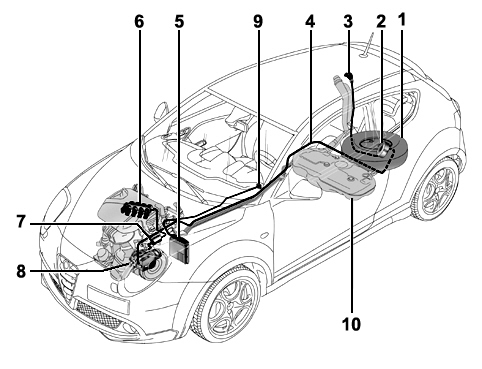
The upgrade of the engine consists exclusively in the addition of the LPG feeding system parts (Fig. 1), namely:
1 LPG tank
2 Multiple valve and safety device unit
3 LPG refuelling filler
4 LPG pipes
5 LPG injection system ECU
6 LPG injectors
7 Gaseous LPG filtering element
8 Pressure regulator
9 LPG / petrol switch and LPG quantity indicator (on the dashboard, on the left of the steering wheel)
10 Petrol tank
Fig. 1 – LPG system components
LPG tank
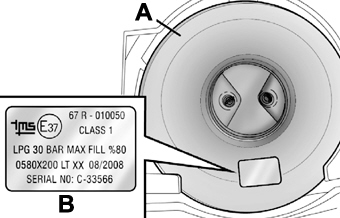
The car is provided with a pressurised LPG tank (A - Fig. 2). The tank is toroidal and is located in the spare wheel compartment. The maximum capacity is 39 litres (with a tolerance of 2 litres).
The LPG in the tank is always in both a liquid and gaseous state, in a state of physical balance between the two stages.
The liquid, which cannot be compressed, expands by around 0.25% for each one degree increase in temperature. For this reason a suitable space is guaranteed allowing the increase in the volume of the liquid for all predictable temperature increases (e.g. car parked in the full sun in summer) without compromising the integrity of the tank.
For this reason, there is a safety valve that automatically limits the refilling of the tank (during refuelling) to a maximum level of 80% of its total capacity.
Remind the customer that:
-Periodically (at least once every six months) it is advisable to let the LPG in the tank run out and, at the first refuelling, check that it does not exceed the maximum capacity of 39 litres (with a tolerance of 2 litres). Inform the dealer immediately if a higher value is found.-The maximum capacity, after different refuelling processes, may vary due to differences between the network pump supply pressures, pumps with different supply/locking features, tank still containing fuel.-With LPG, the car''s range is very variable because, in addition to the car driving and maintenance conditions, it also depends on the composition of the gas which may vary, not only seasonally, but also from supplier to supplier.-They must only use LPG for motor vehicles.Fig. 2
LPG tank certification
The LPG tank is certified in accordance with the regulations in force in the various countries concerned. In Italy, the tank has a life of 10 years starting from the car registration date.
If the car has been registered in a country other than Italy, the duration and the testing/inspection procedures of LPG tank can vary depending on the national legislation in force in that country.
In any case, the tank must be replaced according to the relevant regulations in the various countries.
A plate (B - Fig. 2) on the tank contains the following information:
-type-approving country identification and number;-type of gas it is designed for (LPG);-name of tank manufacturer;-tank commissioning pressure (30 bar);-maximum refilling percentage (80%);-tank dimensions;-rated tank capacity in litres;-tank manufacture date (month/year);-tank serial number.Solenoid valves and safety devices
The system has a solenoid valve located on the pressure reduction unit and a solenoid valve fitted inside the multiple valve assembly on the tank. The main function of these solenoid valves is to interrupt/allow the flow of LPG to the supply circuit.
The solenoid valves are open when:
-a request to run on LPG has been made;-the optimum engine running conditions are satisfied (engine coolant temperature, minimum revs level) for running on LPG;-there is enough LPG in the tank for operation;The multiple valve assembly fitted on the tank includes:
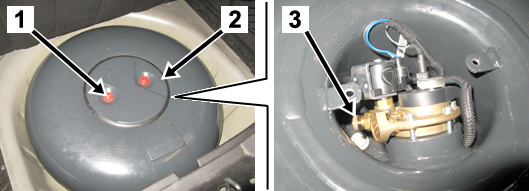
-a valve that automatically stops the supply of LPG when the maximum permitted filling level is reached (80% of the total tank capacity);-a flow limiter which, if a pipe is broken, prevents the complete and sudden escape of LPG;-a one-way valve, located on the gas return pipe in the tank, which prevents LPG counter flow;-a safety solenoid valve on the LPG delivery line for enabling or preventing the leak of gas towards the pressure reducer;-a fuse pad which, in the case of overheating (temperature above 120°C), totally eliminates the danger of excess pressure releasing the LPG in the tank as quickly as possible in a controlled manner;-an analogue gauge showing the level of LPG in the tank;-a manual valve (Fig. 3), positioned upstream of the solenoid valve for bypassing the LPG system for servicing operations. | To intervene on the valve for servicing operations: |
Fig. 3
Pipes
The supply piping for the LPG in a liquid state (from the filler to the tank and from the tank to the pressure regulator) is made from copper and coated in plastic.
The supply piping for the LPG in a gaseous state (from the pressure regulator to the LPG injectors) is made from rubber.
Regulation unit
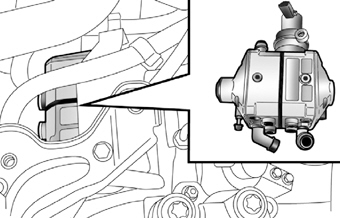
The regulation unit (Fig. 4) includes:
-cut out solenoid valve with mesh filter;-the pressure regulator.the cut out solenoid valve opens or closes together with the solenoid valve on the tank. It cuts off the LPG flow when the engine is not running on gas and doubles as a safety device for cutting off LPG flow when the fuel cut-out system engages.
the pressure regulator allows the LPG to pass from a liquid state to a gaseous state through an expansion chamber and maintains the pressure required for the operation of the system at a preset value.
Fig. 4
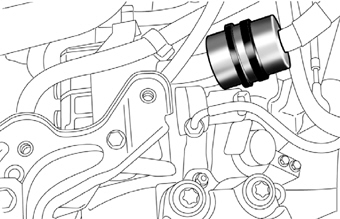
Filter
The filter (Fig. 5) located on the pressure regulator outlet pipe, filters LPG in a gaseous state during the LPG injector supply stage.
Fig. 5
LPG injectors
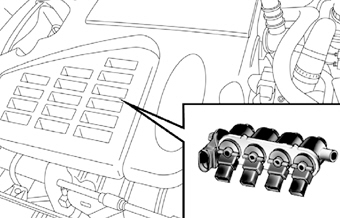
There are four injectors (Fig. 6), specially designed for LPG, mounted on an appropriate bracket on the cylinder head; they are connected by pipes to the single intake ducts.
They are supplied with LPG in a gaseous state at a constant pressure and are controlled by a specific electronic control unit.
A gas pressure and temperature sensor that sends an appropriate electrical signal in order to determine the LPG injection time is fitted on the injectors.
Fig. 6
ECU
The car has a dedicated electronic control unit for the LPG system; it uses the incoming signals from the petrol injection control unit and converts them into signals for LPG injection.
The control unit for the injectors has the same strategy as the petrol control unit (phased, sequential multipoint type).
Miscellaneous
Tyres (Repair kit)
The car is equipped with a tool bag containing tools and a quick tyre repair kit (named Fix & Go Automatic) instead of a spare wheel.
The tool bag is placed in the luggage compartment behind the rear seat backrest.
Passive safety
The car has the same passive safety specifications as other versions. In particular, the tank mountings (located in the spare wheel housing) have been designed to exceed the Alfa Romeo safety standards for impact tests.
When running on LPG, the flow of gas (in a liquid status) leaving the tank, passes through the specific pipe to the pressure regulator, where there is a safety solenoid valve that stops the flow of LPG when the key is removed or when the driver selects a fuel change (decision to run on petrol).
Together with the regulator solenoid valve, a second solenoid valve, in the tank, closes the LPG pipe at the tank outlet.
In the event of impact, the two solenoid valves are closed, after which the engine cuts out due to the fuel cut off system.
| Remind the customer that in some countries (including Italy) there are legal restrictions in force for parking/garaging motor vehicles fuelled by gas with a higher density than air; LPG comes under this category. |
Active safety
The car has the same active safety specifications as other versions.
 | - Altering the configuration of the system and components is strictly prohibited. - the LPG tank must be removed from the vehicle for painting in an oven; although the LPG system has numerous safety features, it is advisable to close the manual valve (3 - Fig. 3) on the tank every time the car is not in use for a long period, is transported on other vehicles or moved in an emergency as a result of a breakdown or accident. |