CONSTRUCTION SPECIFICATIONS
The C510 gearbox installed on the vehicle has been modified compared with the similar gearbox fitted on other models through the addition of new features aimed at improving manoeuvrability.
Its main features are:
- excellent manoeuvrability of the gear control
- quiet operation.
The configuration is transverse with 2 shafts in a cascade configuration and a differential.
The F.E.M. (Finite Element Method) of structural calculation has been used to improve the gearbox casing and the clutch casing in terms of strength and noise absorption.
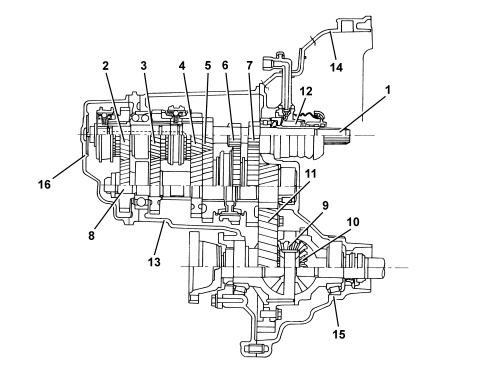
1. Main shaft
2. 5th speed drive gear
3. 4th speed drive gear
4. 3rd speed drive gear
5. 2nd speed drive gear
6. 1st speed drive gear
7. Reverse drive gear
8. Layshaft
9. Satellite gears
10. Planet gears
11. Ring gear
12. Clutch coaxial control
13. Gearbox casing
14. Clutch casing
15. Differential support casing
16. Gearbox casing cover
MAIN SHAFT
The main shaft consists of:
- 1st, 2nd speed and Reverse gears directly on the shaft;
- 3rd, 4th and 5th speed gears fitted on the shaft.
The main shaft is supported by two ball bearings.
LAYSHAFT
The layshaft consists of:
- 1st, 2nd, 3rd, 4th and 5th speed gears fitted on the shaft.
The layshaft is supported by:
- a front roller bearing
- a rear ball bearing.
GEARS
The gears are the following type:
- helical toothed for the forward gears
- straight toothed for reverse gear.
The teeth for all the gears are HCR (High Contact Ratio).
The 2nd and 5th speed and final drive gears are superfinished after the thermal treatment to guarantee absolute precision for the teeth, as well as quiet operation.
The lubrication of the gearing and kinematic components inside the gearbox is carried out dynamically, via oil flowing through the openings in the casings at the 3rd-4th speed rod and the main shaft; this makes it possible to have:
- improved torque transmission and greater efficiency against the effects of wear
- manoeuvrability even at low temperature thanks to the use of synthetic multigrade oil.
SYNCHRONIZSERS
The synchronization for all the forward gears (there is no synchromesh for reverse, it is alwasy engaged with the main shaft to reduce sticking) is the Borg-Warner brass baulk ring type and for 1st and 2nd speeds it is on the layshaft, for 3rd, 4th and 5th speeds on the main shaft and for reverse on the idler shaft (there is no synchromesh).
This solution reduces gearbox noise when parked in neutral because 3 of the 5 pairs of gears are not driven.
The engagement and synchronization loads are also reduced as a result of the corresponding reduction in the inert rotating masses downstream of the crankshaft.
The synchronizer on 1st and 2nd speeds, the most used gears subject to the most stress, is the double cone type requiring far less engagement force compared with a single cone type traditional sychronizer of the same size (- 40%).
A new pre-synchronizer system comprising thrust bearing blocks is used on all the gears to improve sliding and engagement: in 1st and 2nd speeds the free (neutral) gears are supported by roller chambers.
The geometry of the teeth and the kinematic chain have been improved for the engagement of reverse gear producing better manoeuvrability.
DIFFERENTIAL
The differential unit is located in the rear part of the gearbox casing.
It comprises:
- a reduction cylinder pair
- a differential housing in a single piece, incorporating the planet and satellite gears.
The differential is supported by two conical roller bearings.
The planet gears have a splined internal profile in which the two joints connected to the two driveshafts that transmit the drive to the wheels mesh.
The speedometer idler drive gear is fitted on the outside of the differential housing.