CONSTRUCTION SPECIFICATIONS
Introduction
The topics are dealt with paying special attention to the new technical features required for passing the various tests introduced by new legislation.The descriptions and operating information provided are limited to a discussion of principles, rules and minimum precautions.
For information on repair methods and vehicle technical specifications, see the specific sections on repair procedures.
Aerodynamics
The styling of the new vehicle is designed to reflect great personality and originality and improves on the attributes of roominess, practicality and sturdiness achieved by previous models.
The front, sides, rear and underbody were developed with particular attention to aerodynamics and allow outstanding drag coefficient values.
- aerodynamic coefficient CX = 0.31
This value is the result of road testing and measurements carried out in a wind tunnel.
This result contributes to the noiselessness of the vehicle and significantly reduces wind noise, with further fuel saving.
Safety
The main aim of car manufacturers is definitely the total safety of the driver and passengers.
To adapt the vehicle to highly demanding European and international market regulations, the new vehicle was designed with great attention to detail in order to achieve an optimum response in all situations.
Torsional and bending strength
Specifications
The vehicle's high resistance to twisting and bending forces ensures good properties of passive strength and also offers a number of benefits:
-
low noise due to fewer vibrations;
-
no creaking from the trim;
-
better handling by maintaining the correct suspension angles and thus an absolutely controlled drive for a feeling of stability and comfort in general;
-
greater ability to withstand breakages caused by using the vehicle over particularly uneven road surfaces;
-
feeling of vehicle compactness;
-
long-term overall vehicle quality.
Torsional strength (torsion deformation diagram).
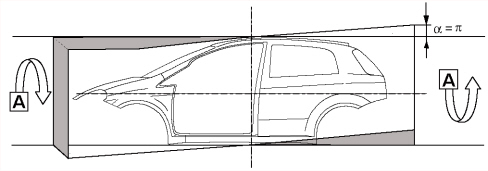
Torsional strength values
Body with bonded windscreen: 101200 daNm/rad
Bending strength (diagram showing deformation due to bending).
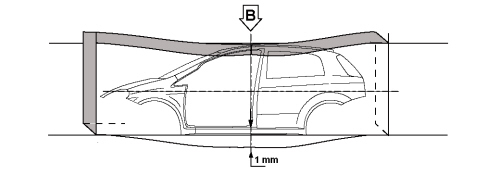
Bending strength values
Body with bonded windscreen: 1070 daNm/rad
SAFETY
Preventive safety
This concerns all factors that determine comfortable driving conditions and prevent situations that could distract the driver's attention:
-
very stiff body for greater driving safety;
-
optimised engine suspensions (centre of gravity type) to minimise vibration and noise transmission;
-
climate control system, dual zone (where fitted) with activated charcoal pollen filter with balanced diffusion throughout the passenger compartment. Well-arranged ventilation outlets allow excellent air exchange and improved transpiration and thermal comfort;
-
an extensive glazed area allows optimum visibility;
-
gas discharge headlamps with self-adjustment function (where fitted);
-
LED rear light clusters with a shape that improves light signalling functions;
-
the arrangement of the pedals, steering wheel (with axial and height adjustment), main controls and warning lights has been carefully considered to achieve a good balance between the driving position and the ability to reach the controls;
-
the height-adjustable driver's seat with lumbar adjustment allows the best possible driving position to be achieved;
-
abundant use of sound-absorbent materials and the adoption of specific vibration-proof fasteners to reduce mechanical noise and achieve a noiseless, welcoming environment;
-
interior trim that meets the toughest flame-retardant standards.
Passive safety
Because in statistical terms head-on impacts account for 60% of accidents, side impacts account for 30% and the remaining 10% are accounted for by shunts, fires and roll overs, the vehicle structure has been designed and developed to crumple in controlled manner in the case of impact and to absorb the energy developed without affecting the living areas of the passenger compartment.
To safeguard the vehicle occupants, the seat anchorage points and seat belt attachment points (a three-part belt is also available on the central rear seat) have been reinforced.
A dual stage activation protection system is fitted, as standard, for the occupants of the front seats; it consists of a driver's Air Bag, dual pretensioners with seat belt load limiters, a passenger side Air Bag (that can be deactivated by the panel setup menu), a front impact detection sensor that helps the main electronic control unit to anticipate the activation of the Air Bags compared to the traditional system, preventing the risk of minor injuries as a result of the activation of the Air Bags. The vehicle is also equipped with (option) front Side Bags for both the driver and the front passenger and Window Bags which extend underneath the roof on the left and right sides protecting the head of the occupants of the vehicle and (optional) Knee Bags that protect the driver's knees.
This model is also equipped with ISOFIX mountings on the rear seats to transport the smallest passengers safely.

|
If the body is repaired, the structural reinforcements should always be replaced if deformed. |
Pedestrian protection
The style of the front part of the vehicle has been developed taking into account the protection of pedestrians as required by the most recent international legislation. The shapes are smooth and rounded and there are no unsafe projections for the safety of pedestrians. The large surface area of the bonnet minimizes the risk of contact between pedestrian's heads and the rigid front pillars.
The most rigid components are located in the engine compartment at suitable distance from the bonnet to allow the skin of the bonnet to absorb low level energy forces from the impact against the head of a pedestrian.
WINDSCREEN AND WINDOW GLASSES
The fixed windows are a further safety feature.
To increase the vehicle safety level, the windscreen is in laminated glass. This solution prevents the glass from shattering if struck by stones or gravel to assure visibility at all times and above all to offer a high level of protection if struck with the head.
The windscreen is bonded to the bodyshell, thereby contributing to increasing the structural rigidity of the vehicle: the seal on the window contributes to reducing the noise due to oncoming air (wind noise).
Safety against fires
This is achieved by a FPS (Fire Prevention System) consisting of:
-
fireproof interiors, all trims meet the toughest US flame-retardant standards and will not catch fire if they accidentally touch a heat source (e.g. a cigarette) and limit the flame propagation rate;
-
inertia switch to cut off the fuel pump;
-
antimisfiring shields (overheating of the catalytic converter, on petrol versions) that insulate the catalytic converter and protect the brake and fuel pipes;
-
electrical equipment protected by maxi fuses that cut off the fuel flow in the case of short circuit or overheating that could occur in the event of fire;
-
battery secured in the event of impact or roll-over;
-
cut-off valve to prevent fuel leaks if the vehicle rolls over;
-
plastic fuel tank with high mechanical strength and fire-resistance, secured firmly to the body in a shielded position;
-
arrangement of the electrical equipment, fuel pipes and brakes designed to minimise the possible risk of fire in the event of accidents or failure.
Sound insulation
To meet EEC standards, the vehicle's exterior noise levels must be lower than 74 decibels.
Driving comfort and living conditions inside the passenger compartment have been improved by:
-
optimising the body through a thorough examination of all parts subject to noise, which have been made stiffer and the fastenings which have been reinforced;
-
choosing contact materials with great care;
-
improving the insulation against noise transmitted from the road surface, from mechanical parts and from the suspension;
-
taking great care over parts assembly, aerodynamics and all parts with shapes that affect acoustic comfort, such as door handles, door mirrors, bumpers and other outlines;
-
fitting new generation engines with high-tech features designed to improve acoustic/vibrational factors;
Another area of improvement has been the passenger compartment insulation. The following action has been taken:
-
highly efficient sound-absorbent materials with optimum thickness and layout on the vehicle;
-
adoption of a sound-absorbing ceiling with air spaces with a consequent improvement in sound insulation of 2 dB (A);
-
fitting of a sound-absorbent undershield in the lower part of the engine compartment for acoustic insulation;
-
elimination of acoustic holes (areas where sound can pass between the engine compartment and passenger compartment) by fitting double-lipped seals, thicker rubber plugs;
-
tighter fitting of the various sound-insulation parts together to avoid uncovered areas;
-
extensive use of sound-absorbent seals;
-
sound-proofed coating of panels with heat-bonded materials applied before painting;
-
lining of the bulkhead and front footboards to remove the feeling of the engine's presence;
-
application of heat-expanding materials inside the box sections prior to painting to reduce noise transmission. During the body cataphoresis processes, the volume of these materials expands ten times to fill the box section effectively;
-
lining the boot compartment appropriately to reduce rolling noise;
-
carefully examining the fitting and size of parts liable to squeak such as the dashboard, heater and seats: the anchorage and fastening points have been reinforced.
|
|
To maintain the high level of acoustic comfort achieved, the specifications adopted during manufacture must be restored exactly in the event of repair. |
PROTECTION OF THE BODY
Anti-corrosion protection
The bodyshell of the New Lancia Delta has been designed to combat the harsh weather conditions in the most critical markets, such as Central Northern Europe where salt is used on the roads to prevent freezing.
With this in mind, design features have been introduced to ensure complete accessibility of the bodyshell for the protection and painting processes (especially the application of anti-rust protection through electro-deposition, known as cataphoresis). The shape of all elements is important to prevent the possible build up of dampness in the internal structures.
This includes the design of the panel joints (shape and dimensions) in order to make them suitable for the sealing operations, which are essential both in terms of water tightness and sound insulation of the vehicle.
Galvanized panels
The zinc deposited in a continuous layer on the surface of the panel constitutes the first line of defense against the corrosion of the steel. The zinc layer acts as an active chemical protection for the steel, known as a sacrificial protection, that combines with the subsequent protective systems of the painting cycle to guarantee outstanding long term corrosion proofing.
The galvanizing of the panels takes place directly in steelworks through two different technological processes, both capable of ensuring constant thicknesses of zinc with a high standard surface finish:
- Galvanizing: the panel is immersed in a solution of zinc salts which, through the electrolytic effect, deposits a layer of pure zinc; the normal thickness of the zinc deposited is 8-10 microns.
- Hot galvanizing: molten zinc is deposited on the panel due to the effect of heat. In this case too, the normal thickness of the zinc is 8-10 microns, but thickness of up to 20 microns, to be used for the parts most exposed to corrosion, can be produced using this process.
The two processes allow galvanizing on both sides of the panel.
It is therefore possible to produce simultaneous protection for both the inside and the outside of all panels and, in particular, protection of the surfaces in contact with several elements welded together.
Panels galvanized on both sides account for 90% of the vehicle body weight.
In particular, all parts that make up the chassis, most exposed to corrosive agents, are 100% galvanized.
Of these, the structures defined as safety structures, such as the suspension mountings and reinforcements for the seat belts, are made from panels with a high zinc thickness, up to 20 micron.
The body is made entirely from 8 microns galvanized panels for the doors, bonnet, boot lid, side panels, wings and roof.
Only some inner parts of the passenger compartment are an exception because they are not at any risk of oxidation.
Anti corrosion tests
All anti corrosion provisions made have been subjected to laboratory tests and they have performed well in accelerated tests on vehicles carried out in special test areas, where the most stringent conditions of the central northern European markets have been reproduced.
Anti corrosion objectives
The anti-corrosion provisions adopted make it possible to satisfy the following anti corrosion warranties:
- 3 years of the vehicle's life without cosmetic corrosion points
- 8 years of the vehicle's life without panel perforation in the harshest Northern European climates.
In addition, the protective package made up of medium-high thickness galvanized panels plus cataphoretic treatment of the entire structure makes it possible to comply with the European regulations concerning safety features (10 years of the vehicle's life without structural weaknesses).
Painting
Specifications of the painting cycle
The aim of painting the body is to:
- protect the sheet metal against corrosion due to exposure to environmental factors;
- achieve high levels of gloss and colour richness and maintain them in time.
Before being subjected to painting, the bodyshell undergoes a pretreatment process known as bonderization in various stages, the most important of which are degreasing and the subsequent phosphatization treatment.
The latter forms a crystalline layer of phosphate which makes up the base on which the subsequent painting layer is applied through cataphoresis.
Painting through cataphoresis is a fundamental treatment for the protection of the structural elements.
It allows the paint to be deposited in areas of the body that would otherwise be inaccessible, such as the internal box structures, if properly designed.
The process takes place through immersion in an electrically insulated vat containing an aqueous solution of a hydrosoluble paint product.
The solution is negatively charged, whilst the body is positively charged. During immersion, a layer of paint is deposited (22 microns on horizontal parts and 20 microns on vertical parts).This can be adjusted by altering the bath voltage, the bath temperature and the length of time the body remains in the solution.
Later on, the bodyshell undergoes a stoving process in an oven at a temperature of around 160°C for about 20 minutes in which the paint film reticulates.
The sound insulation materials are applied to the bodyshell prepared in this way and all the joints between the body panels are sealed to prevent the penetration of corrosive agents; then the anti-abrasion/anti-stone chipping protection is applied to all surfaces of the underbody exposed to stone chipping.
At this point the painting cycle continues with the application of an undercoat (about 30 microns thick) followed by a further stoving cycle in the oven at 150°C for about 20 minutes.
Lastly, the aesthetic finish is applied in the form of a layer of base enamel (colour), followed by a layer of transparent resin with good resistance to outside agents (dampness, scratches, solar radiation) and the final stoving in the oven at 140°C for about 20 minutes.
The production plant uses water formulated environmentally-friendly enamels.
The table illustrates the painting process for the vehicle.
Body painting cycle
|
DEGREASING |
BONDERIZATION The body is cleaned down to the panel surfaces and a layer of phosphate micro crystals is deposited. This forms an ideal base for the subsequent painting. |
|
PHOSPHATING |
|
|
CATAPHORESIS |
APPLICATION OF CATAPHORESIS All inner and outer surfaces of the body are covered in a layer of anti-rust paint through a cataphoretic process. The layer deposited is then stoved in an oven. |
|
STOVING |
|
|
SEALANTS, SOUND INSULATION, UNDERBODY PROTECTION |
APPLICATIONS FOLLOWING CATAPHORESIS The bodyshell receives all the materials required for the sealing of the passenger interior compartment to prevent penetration of the box sections, to sound-proof the vehicle and protect it from stone-chipping. It then receives the paint undercoat which is the ideal base for the subsequent application of the enamel. All these materials are stoved in a special oven |
|
PAINT BASE COAT |
|
|
STOVING |
|
|
ENAMEL + CLEAR RESIN |
APPLICATION OF THE ENAMEL The bodyshell receives the final layer of enamel, which has excellent aesthetic properties and resistance to environmental agents, on all the visible surfaces |
|
STOVING |
Identification
The vehicle colour range includes:
- pastel colours;
- metallic colours.
Both are produced through the application of a pastel or metallic base coat and clear resin (double layer).
The vehicle colour type and specifications are shown on the identification plate which carries the following information.
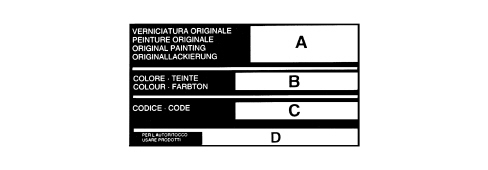
A - Paint product supplier
B - Enamel colour and type
C - Colour code
D - Type of product to be used for touching up and painting in the event of service operations
RECYCLABILITY OF MATERIALS
RECYCLING OF MATERIALS
Main specifications
According to EEC ELV (End of Life Vehicles) directives, all metallic and non-metallic parts must be recovered from the vehicle and reused, 80% to produce new material and 5% for recovered energy. Nowadays, some 75% of a vehicle's weight is made up of metal that can easily be recovered by melting when different metals can be separated by heating thanks to their different melting points. All the remaining part of the vehicle, amounting to 25% of the weight, must be recovered before this stage. The solution to the problem of recycling plastics is resolved at the design stage: the possibility of reusing the material on future components must be assessed at this time.
The aims to be considered at the design stage include:
-
ease of component disassembly;
-
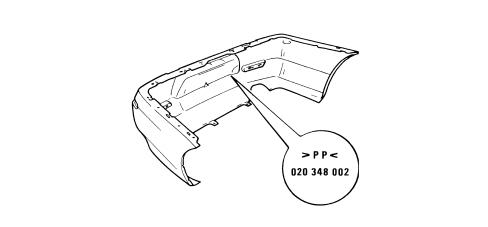
choice of "noble" materials in the recyclable polymer chain (giving priority to parts made up of a single family, e.g. PP).
A part cannot be recycled to produce a part that is the same as the original part because the material may not be able to guarantee the necessary levels of reliability or it may not be financially viable.
Plastics may be recycled in a cascade pattern. For example:
-
insulating material for the building industry is obtained from seat padding;
-
the material used to line the wheel arches is obtained from the bumpers and then goes on to produce sound-proofing elements. In the end, it becomes a fuel for energy production.
This model has been designed to ensure that all its plastic and elastomer parts (rubbers) weighing over 50 grams are marked with coded symbols to identify the material during recycling and also to ensure that all its components are recyclable.
The recycling process therefore affects three successive vehicle generations to help save raw materials.
Other material reuse processes are also being examined outside the motor industry, following the lead taken by the F.A.Re (Fiat Auto Recycling) partnership in the Eighties and Nineties.
Another important point to note concerns the use of heavy metals in the motor industry. The metals in question are hexavalent chrome (Cr6), mercury (Hg), cadmium (Cd) and lead (Pb). These are banned (Cr6) or permitted only in tiny amounts when their use must be indicated by labelling or by including information in the documents supplied with the vehicle.
The tables in the chapter "GENERAL INFORMATION AND TECHNICAL DATA - OPERATING DATA" show symbols for, and descriptions of, recyclable materials present on the vehicle. This is to ensure that the best available products are used for washing the interior, painting of plastic parts and carrying out repairs, bonding etc. The aim is to avoid the possibility of damage by using incompatible products. Labelling also allows organic materials to be selected on the basis of their chemical composition. During servicing, it is also advisable to separate materials on the basis of their composition to ensure that they can be recycled more easily.
Diagram showing the reuse of recycled materials
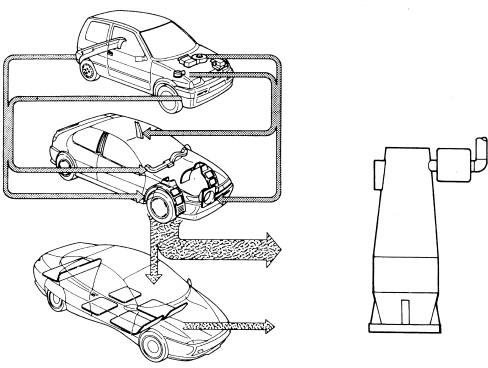
Labelling of part of the recyclable material
Panels
Technical aspects
Over the last 10 years the resistance to traction of structural steel has tripled. These are high strength steels if the attrition load is less than 310 MPa and ultra-high strength if a figure of at least 450 MPa is reached. High strength steels have a specific weight that can be compared with that of traditional steel.
The mechanical properties of high strength steels depend on the phosphorous and manganese silicates present in small quantities and on the extremely low carbon content.
HSLA steels (high strength low alloy) have particles with reduced dimensions and consequently high resistance and excellent mouldability when cold.
Multiphase steels have an even better mouldability/attrition ratio since the very tough basic structure incorporates other high strength phases (e.g. Dual Phase steels) containing 5 - 20% martensite dispersed in ferrite. The resistance increases during machining.
Trip (Transformation induced plasticity) is a steel with an attrition limit above 700 MPa which contains a large amount of residual austenite which, when deformation takes place, is transformed into martensite: this produces extremely high resistance to fatigue and good deformability.
The properties of high strength steels deteriorate over time: they cannot be stored for long periods. As far as rigidity and fatigue are concerned, their behaviour is exactly the same as low carbon content steels.
The world of the car
The use of high strength steels by manufacturers has increased considerably over recent years; nowadays the problem of repairing high strength steel panels is of current significance.
The producers of high strength steels have put forward new solutions capable of competing with aluminium alloys.
High strength steels: types and properties
Long band rolling-mills, cold rolling-mills, the extensive check on procedures and continuous annealing are at the basis of the new generation of high strength panels produced in various types.
Rephosphorated steels are being increasingly used in automotive engineering: the panels, produced in thicknesses of less than 0.25 to 0.5 mm have good mouldability, deep-drawing and stretching properties. Their strength is due to the small amounts of phosphorous and manganese silicates and the extremely low carbon content which improves mouldability even further.
HSLA steels have increased resistance and excellent mouldability when cold through the reduced dimensions of the particles produced with small quantities of NbCN and TiC alloy precipitates. The thin HSLA steel panels can be used for pressing and those with a thickness of more than 2 mm allow small bending radii.
Multiphase steels have an even better mouldability/attrition ratio. This feature is achieved by incorporating other high strength phases in the basic structure made up of very tough phases; in particular, in Dual Phase steels the final microstructure comprises 5 - 20% martensite dispersed in ferrite. These are high attrition steels, produced in very thin densities, sufficiently mouldable and with a high hardening capacity.
High percentages of hard phases, together with extremely fine precipitations of soft phases are a feature of steel microstructures with an attrition limit above 700 MPa. Trip steel (Transformation induced plasticity) has a high percentage of residual austenite which tends to transform into martensite when deformation takes place which confers extremely high resistance to fatigue and good deformability. The cost of production, high flexible return and wear of the tools used for machining are, however, problems.
The current development of high strength steels is directed, in the main, at improving machinability for plastic deformation: high mouldability can be produced, without a reduction in mechanical properties, through the continuous annealing of the panels when cold. BH steel is designed for good pressing qualities: after deformation the resistance increases with an ageing mechanism through carbon activated by a painting cycle.
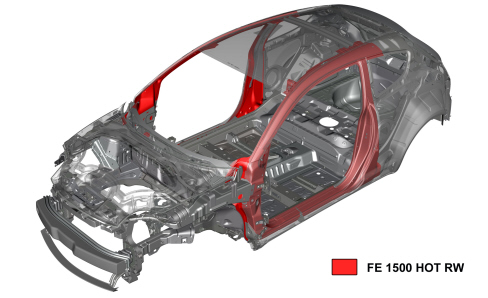
The bodyshell components made from hot pressed FE 1500 HOT RIV steel (that cannot be repaired) are illustrated in the diagram below.
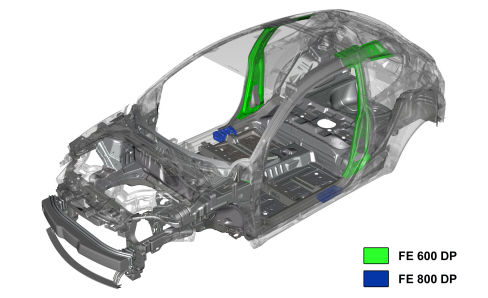
The components of the bodyshell made from FE 500 DP F ultra high resistance steel are illustrated below.
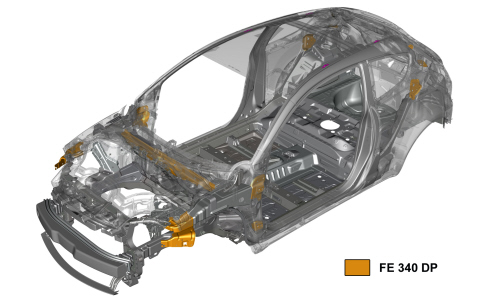
The components of the bodyshell made from FEE 340 F high resistance steel are illustrated below.
The table summarizing the high resistance steels used on the vehicle is below.
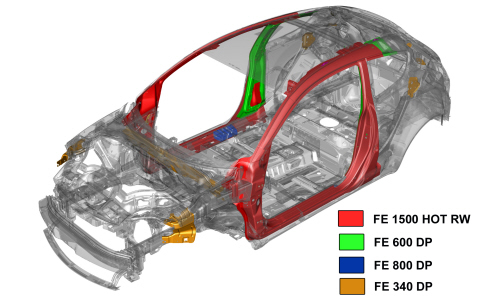
Some figures relating to welding carried out using a spot welder are given in the table below purely by way of example.
|
Standard panel thickness (mm) |
Active electrode section diameter (mm) |
Minimum rated welding current [A] |
Maximum rated welding current [A] |
Hot time (periods) |
Force at the electrodes [daN] |
|
0,8 + 0,8 |
6 |
9000 |
11000 |
9 |
225 +/- 10 |
|
1 + 1 |
6 |
9000 |
11000 |
11 |
260 +/- 10 |
|
1,2 + 1,2 |
6 |
9000 |
11500 |
12 |
300 +/- 10 |
|
1,5 + 1,5 |
6 |
9500 |
11500 |
14 |
350 +/- 10 |
|
0,8 + 0,8 + 0,8 |
6 |
10000 |
12000 |
11 |
260 +/- 10 |
|
1 + 1 + 1 |
6 |
10000 |
12000 |
13 |
300 +/- 10 |
|
1,2 + 1,2 + 1,2 |
6 |
10000 |
12000 |
15 |
350 +/- 10 |
|
1,5 + 1,5 + 1,5 |
6 |
11000 |
13000 |
16 |
400 +/- 10 |
|
1,8 + 1,8 |
8 |
9000 |
11500 |
6 |
400 +/- 10 |
|
2 + 2 |
8 |
9000 |
12000 |
7 |
450 +/- 10 |
|
2,2 + 2,2 |
8 |
9500 |
12500 |
8 |
450 +/- 10 |
|
2,5 + 2,5 |
8 |
10000 |
13000 |
9 |
470 +/- 10 |
|
2,75 + 2,75 |
8 |
10700 |
13500 |
8 |
500 +/- 10 |
|
3 + 3 |
8 |
11000 |
14000 |
9 |
550 +/- 10 |
1 Period = 1/50 second
These figures are and should only be an example for high and ultra high strength materials; the parameter that changes the most is the "force at the electrodes" which increases from 10 to 30% depending on the increase in the thickness and properties of the material.
Obviously as it is not possible to provide specific details for every individual welding machine it will be the responsibility of the mechanic depending on the power of the equipment available to apply the logic described previously.
TYPICAL BODY MEASUREMENTS
ADJUSTMENT OF MOVING PARTS
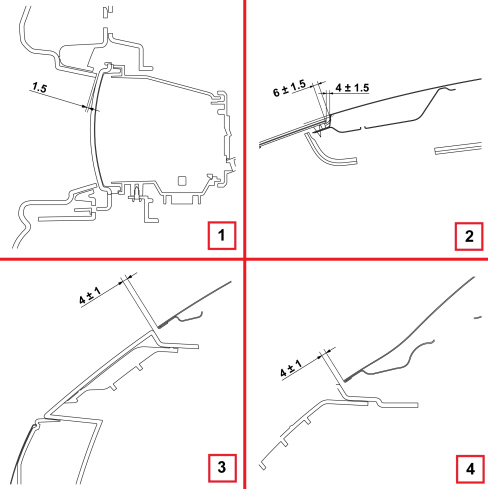
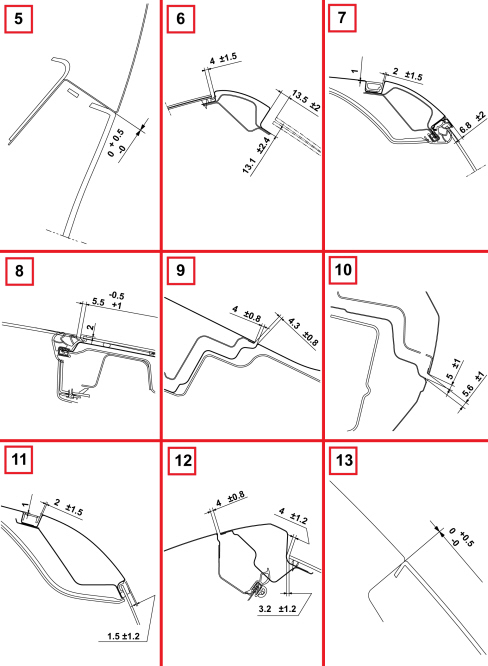
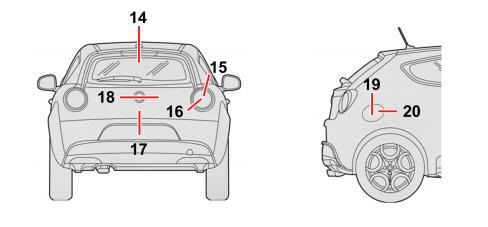
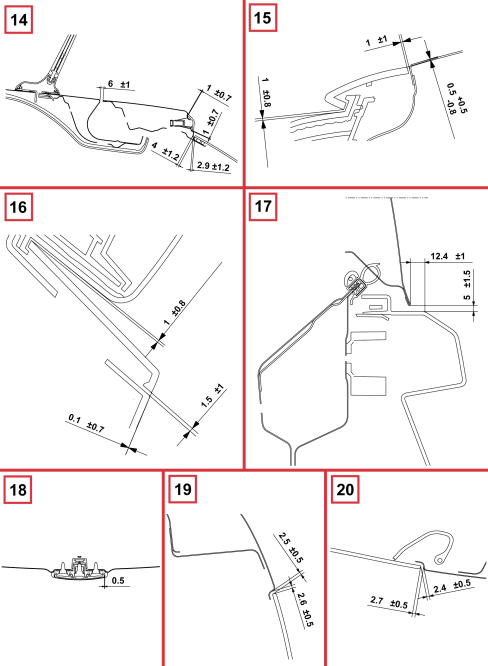
Measurements for the adjustment of the moving parts
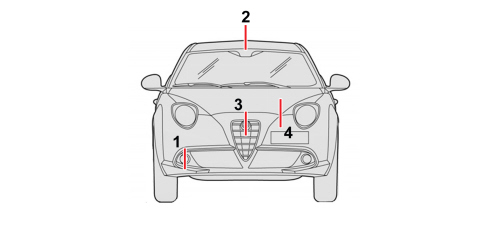
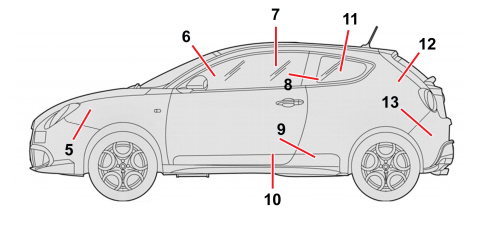
To facilitate and verify moving part disassembly operations, the existing gaps are shown (in millimetres) to allow appropriate adjustment.
The adjustment procedure is explained in the sections describing moving part removal and refitting procedures.
Front view of vehicle with position for measuring gaps between the moving parts (measuring points from 1 to 8)
Side view of vehicle with position for measuring gaps between the moving parts (measuring points from 9 to 19)
Rear view of vehicle with position for measuring gaps between the moving parts (measuring points from 20 to 28)
SEALANT APPLICATION
When it is not specified, the sealant used is the hot hardening type for interiors.
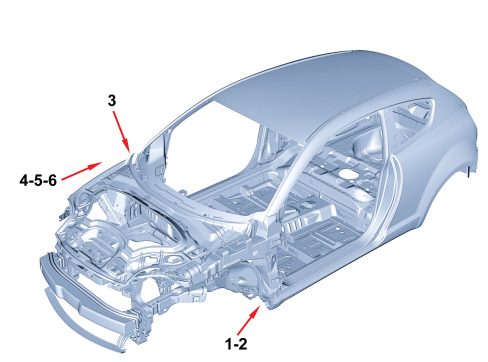
Detailed application of sealant in areas 1 to 6
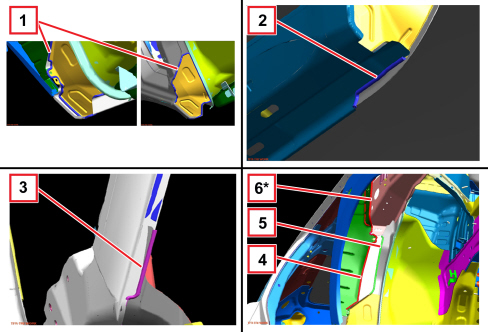
1. External side panel - side panel lower closing
2. External side panel - post reinforcement
3. External side panel - post reinforcement
4. External side panel - front mudguard
5. External side panel - front post reinforcement
6. Front mudguard - front upper strut
(*) High consistency filler putty
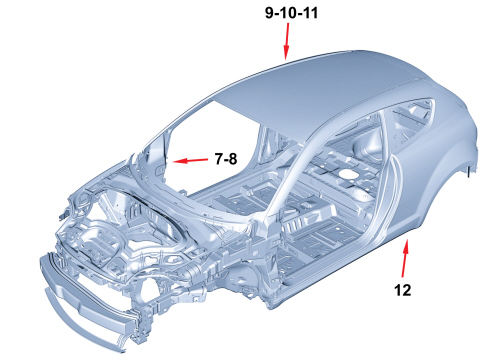
Detailed application of sealant in areas 7 to 12
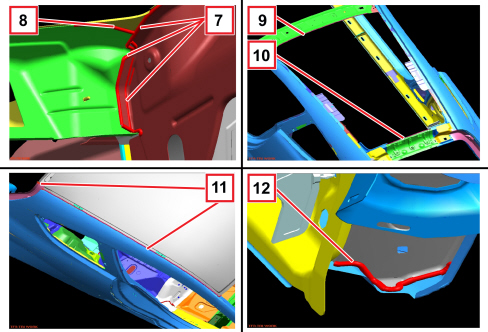
7. Windscreen lower cross member - windscreen post longitudinal member
8. Windscreen lower cross member - windscreen lower cross member guard
9. Roof front cross member - roof external coating
10. Roof rear cross member - roof external coating
11. External side panel - roof external coating
12. Side frame lower guard - external side panel
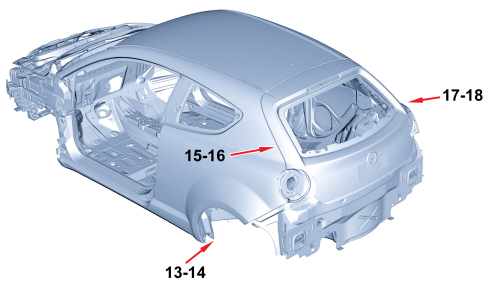
Detailed application of sealant in areas 13 to 18
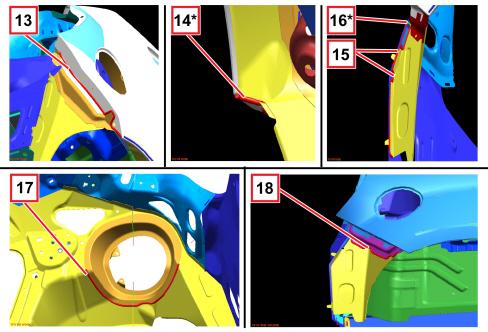
13. External side panel - rear lower structure
14. External side panel - rear lower structure
15. Rear side frame - rear trim
16. Rear side frame - rear structure
17. Rear side frame - fuel filler base
18. Rear side frame - lower rear guard
(*) High consistency filler putty
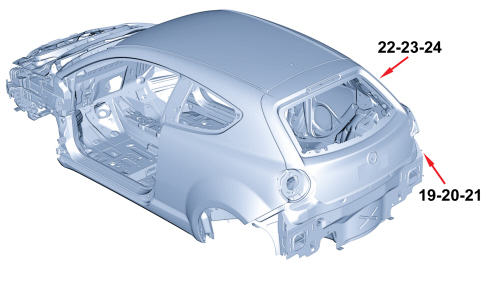
Detailed application of sealant in areas 19 to 24
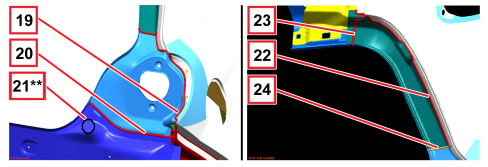
19. Light base - external side panel
20. Light base - rear trim
21. Rear external trim - tailgate frame buffer
22. Water drain channel - external side panel
23. Water drain channel - roof trim
24. Water drain channel - light base
(**) Abrasive gasket
Detailed application of sealant in areas 25 to 27
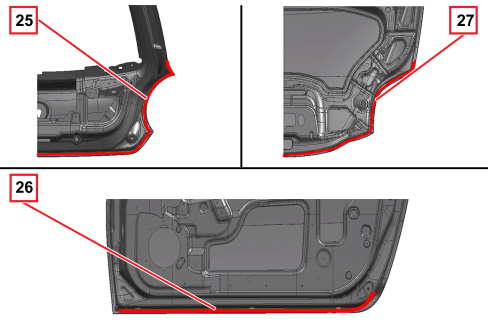
25. Tailgate
26. Door
27. Bonnet