GENERAL INFORMATION
GLOSSARY
Lpg
LPG (Liquid Petroleum Gas) is a mixture of hydrocarbons (propane, butane, isobutane, propylene, etc.) that are in a gaseous state at atmospheric pressure.
At normal environmental temperature, the mixture can be liquefied at a relatively low pressure (8 bar).
LPG FEATURES
LPG is obtained mainly from:
-
oil refinery processes
-
degassing of natural gas (separation of liquid hydrocarbons present in natural gas)
Like all petroleum gases, LPG is heavier than air, colourless and odourless. A scented additive (Mercaptan) is added so that its presence can easily be detected.
Due to its composition, LPG can easily be converted from its natural gaseous state (15 °C) to a liquid state by applying a slight pressure increase (7.5 bar).
Due to these properties, the gaseous part (1) and the liquid part (2) are in a state of equilibrium in the tank.
Whenever LPG is drawn off, part of the liquid evaporates to re-establish the equilibrium between liquid and gas.
Because the volume of liquid LPG increases by 0.25% for each degree centigrade temperature increase, it is essential to ensure that the tank is filled to only 80% of its capacity at most to allow the liquid to expand as the temperature (environment, vehicle operation) increases.
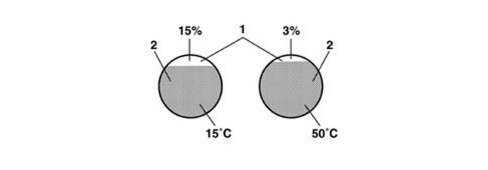
LPG has been used in automotive engines since the Fifties. It is popular due its excellent antiknock properties and the fact that combustion takes place without the formation of residues in the combustion chamber.
Because they do not contain aromatic compounds or additives such as sulphur and lead, emissions produced by LPG combustion pollute significantly less than petrol engine emissions.
An engine can be converted to run on LPG by changing the material used for the valve seats and adding the parts included in the LPG supply system i.e. cylinder, inlet pipes, a pressure regulator, special injectors and an LPG supply management electronic control unit. The valve seats must be made out of material that is very resistant to wear and heat because, unlike petrol, LPG is a very poor lubricant.
LPG is injected into the individual intake ducts to create a Timed Sequential Multipoint system similar to that used for conventional petrol fuel (unaltered).
This new LPG injection system has been adopted due to a need to make the use of LPG more economical and also improve performance and emission control.
WARNINGS AND PRECAUTIONS

|
LPG systems may be serviced only by staff who have attended a LPG training course in the different methods chosen by each market. Authorised staff must comply with current legal regulations and take care to observe all safety requirements learnt during the training course. The standards listed below must be observed during any operation carried out on a vehicle equipped with an LPG system. |
Although Liquid Petroleum Gas (LPG) fuel systems are no more dangerous in practice than normal petrol systems, they need special attention, particularly with regard to servicing.
In particular, when opening connectors or moving pressurised components, operators must be equipped with helmets with face visors (1) to UNI-EN 166 standards to protect against spray and winter gloves (2) to UNI-EN 388 and UNI-EN 511 standards to protect their hands against frostbite due to the heat absorbed by the expanding LPG.
Wear cotton or woollen clothing and antistatic safety shoes. Avoid synthetic clothing. Wear antistatic clothing suitable for covering also the lower and upper limbs.

The system used on this vehicle meets requirements in the individual countries where it is marketed.
One-way valves are fitted to the tank next to the LPG supply pipes from the filler and prevent gas accidentally flowing out from the tank.
The solenoid valve on the tank near the supply pipe and the one on the pressure regulator, isolate both sections of the supply pipe when the petrol mode is selected or when the engine is off.
Despite the presence of these devices, it must be remembered that LPG is still a gas under environmental conditions and thus can easily explode. Always observe the following warnings when leaks are potentially present and during any service operations on the system.
-
do not smoke.
-
do not use naked flames.
-
do not use driers and power tools.
-
do not use incandescence lamps.
-
do not wear acrylic clothing that generates static electricity.
-
always disconnect the battery terminals.
-
when the vehicle is in the workshop, do not park near inspection pits, intake port drainage wells or any closed area without sufficient ventilation. Danger of explosion: LPG is heavier than air and tends to sink to the lowest possible level. It will therefore fill any openings near the vehicle to create dangerous, potentially explosive pockets of gas.
-
do not use workshop tools such as air compressors, current generators, suction devices, power tools etc. that could generate sparks and trigger explosions in the event of leaks.
-
do not use any type of suction device; always work in ventilated areas.
-
do not take vehicles with LPG systems into closed environments if they have been in an accident or if the condition of the system seals is unknown.
If the car goes into a drying oven after painting, at temperatures over 80°C, the LPG control unit and the LPG tank must be removed from the car itself.
The system is provided with a fuse pad which, in the event of overheating (temperature above 120°C), totally eliminates the danger of excess pressure, releasing the LPG in the tank as quickly as possible in a controlled manner.
Instructions for painting interventions and drying on vehicles with lpg system
In the event of operations on the bodywork of vehicles equipped with LPG system, involving painting and subsequent drying using lamps, comply with the following precautions:
-
carry out a system seal test; see operation 1043A04;
-
make sure that the level of LPG inside the tank is lower than 80% of the rated capacity;
-
drain LPG from the pipes according to the procedures and complying with the provisions in force described in the operation 1043A02;
-
make the required bodywork repairs complying with the standard procedures for petrol-fuelled vehicles.
|
|
LPG system components, and the tank in particular, should not be exposed to naked/direct flames or high temperature heat sources (e.g. electric welding, etc.). In any case, no component must never exceed a temperature of 80 °C at any point. |
At the end of the operation, wait until the vehicle has cooled down, then start the engine and make sure there are no irregularities during LPG operation.
|
|
If the risk of exposure to direct flame or high temperature of LPG system tank and components is unavoidable, disassemble the tank and drain all pipes. If the components of the LPG system are disassembled, a new check of the circuit's seal is compulsory; see operations 1043A04. |
CONSTRUCTION SPECIFICATIONS
4 cylinder in line 1368 cc FIRE TURBO engine, with DOHC, 16 valve timing system and engine management with Bosch ME 7.9.10 integrated electronic injection/ignition system.
The unit is a system comprising of the engine and all the systems it requires to operate:
-
petrol supply system
-
LPG supply system
-
air supply system
-
exhaust system with catalytic converter
-
fuel vapour recirculation system
-
engine cooling system
-
engine lubrication system
This power unit comes with two fuel systems so that it is able to run equally well on conventional fuel "petrol" or Liquefied Petroleum Gas (LPG).
The dual fuel system comprises the basic petrol system (Bosch ME 7.9.10) and the integrated SDU system (Smart Driver Unit) for LPG/petrol injector control.
The two control systems are connected by special wiring (front, engine pre-wiring, LPG injection).
The SDU LPG/petrol injector control system is transparent to the basic system for all components and the operation of the basic system is not affected in any operating condition.
The two control units share several elements of the system. The sharing is transparent to the basic system (for further details see "Description and operation - Subgroups 1056 and 1057").
The transformation of the engine exclusively consists in the addition of components for the LPG fuel supply system, in other words the cylinder, the injector rail, special injectors, a pressure regulator, and LPG injection control unit, a special electric system, special valves and pipes for LPG.
The system features the injection of the LPG fuel into the individual intake ducts, thereby creating a Timed Sequential Multipoint injection system similar to the one for traditional petrol systems (unaltered).
The advantage of this solution is the fact that it in no way alters the driveability and performance of the vehicle with the engine running on petrol. During LPG operation driveability is perfectly aligned with that of petrol fuel operation.
In addition, harmful exhaust emissions are reduced in LPG operating mode.
Fuel supply system
There are two separate fuel supply systems.
The fuel supply system is the returnless type, i.e. with a single connecting pipe between the fuel tank and the engine.
The LPG system includes a cylinder, a pressure reduction unit and specific injectors located on the intake manifold (for further details see "Description and operation - Subgroup 1043").
Air supply system
Air supply system with a modified intake manifold to allow the fastening of the inlet connectors for the LPG coming from the dedicated injectors.
Exhaust system
The exhaust system has a post-treatment system for the exhaust gases with two oxygen sensors, one upstream and one downstream of the catalytic converter fitted in the engine compartment (for more details see "Descriptions and operation - Subassembly 1076").
Emission control system
The emission control systems used on this model are as follows:
-
exhaust emission control system with three-way catalytic converter and two oxygen sensors, one upstream and one downstream of the catalytic converter;
-
crankcase vapour/gas recirculation system;
-
fuel evaporation control system (for further details see "Descriptions and operation - Subassembly 1080").
Cooling system
Forced circulation with centrifugal vane pump (for further details see "Descriptions and operation - Subassembly 1088").